Protect What Matters Most. From Every Angle.
From burglar alarms and cameras to smart intercoms and automated gates: a complete guide to securing your Singapore landed home, system by system.
Serving Private Estates Since 2006
Four Systems. One Complete Home.
The best security system for a landed home is not the most expensive one. It is the one designed around how your family actually lives: who comes and goes, what keeps you up at night, and what gives you genuine peace of mind whether you are home or overseas.
For most Singapore landed homes, the answer starts with four systems: a burglar alarm, CCTV cameras, a video intercom, and an automated gate. Each does a specific job. Together, they give you complete control of your property.
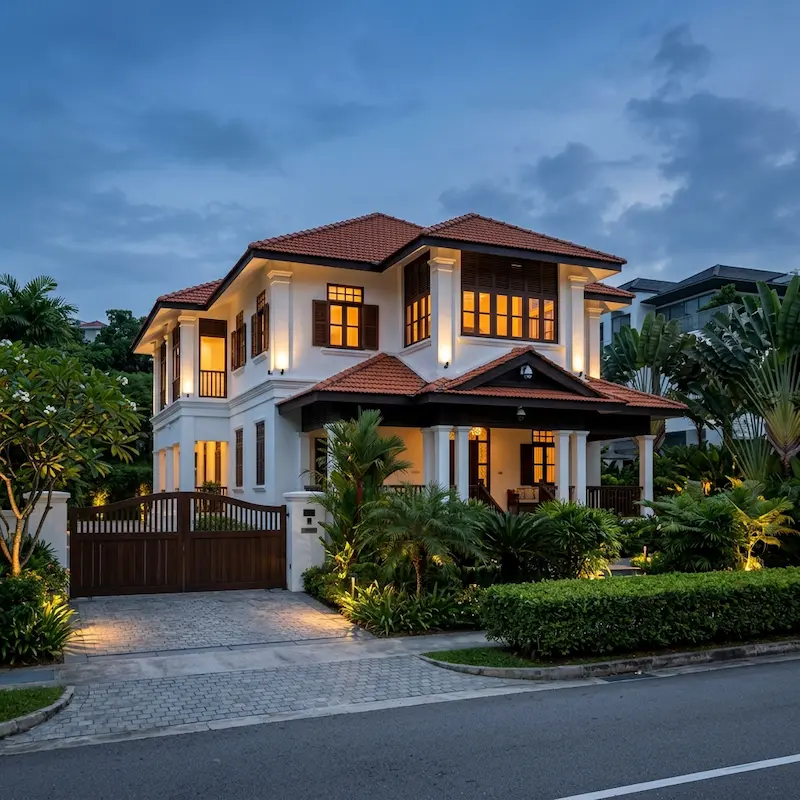
Burglar Alarm & Intrusion Detection
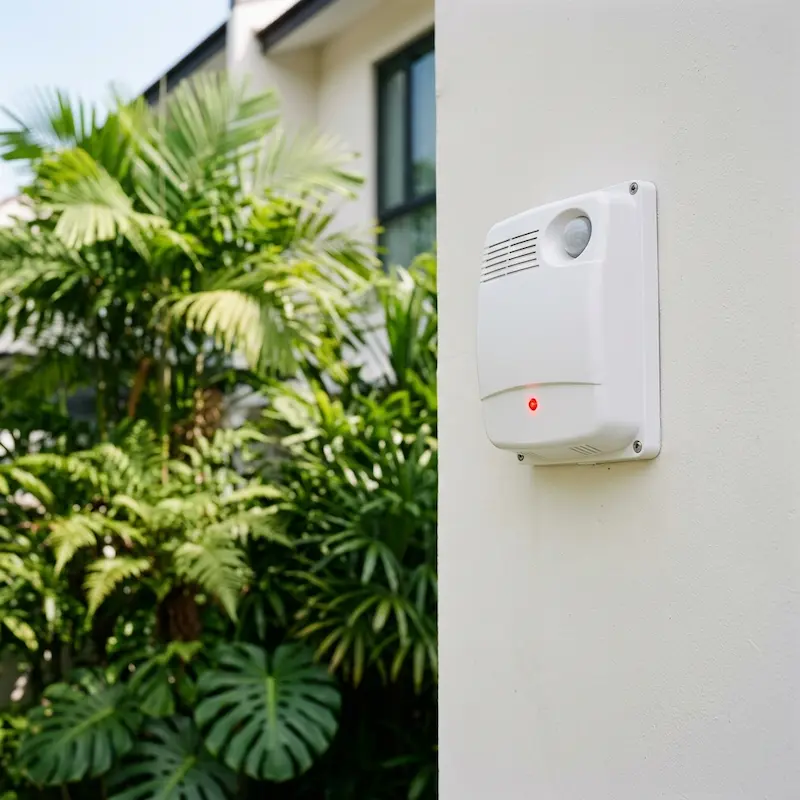
Research consistently shows that homes without a visible security system are three times more likely to be targeted by burglars. The reason is simple: opportunistic break-ins are driven by perceived risk. A prominently mounted external siren box on the front of your home: even before it ever triggers: changes that calculation. It signals that the property is monitored, alarmed, and not worth the risk.
Beyond deterrence, a burglar alarm detects and responds when something actually happens. PIR motion detectors on ground floor corridors pick up movement the moment someone enters. Door and window contacts on every accessible opening trigger instantly if a door is forced. Glass break sensors respond to the sound frequency of shattering glass: catching break-ins that bypass the door entirely. When any zone triggers, the external siren fires, an app alert reaches your phone with the zone that activated, and: if you have opted for a monitoring centre connection: a human operator receives the signal and can dispatch a response.
For families who travel frequently or have elderly members living alone, the monitoring centre option adds a critical layer: someone is always watching, even when you are not.
The Specification: We specify RISCO alarm systems for Singapore landed homes: available in wired and wireless configurations. Wireless detectors are the standard for retrofit installations where running cables through plastered walls is disruptive. For new builds, we run dedicated alarm cable at first fix alongside conduit for cameras and data.
What to consider:
- A visible external siren box on the front facade is one of the most cost-effective deterrents available: position it where it is clearly seen from the street.
- Battery backup is non-negotiable: the system must continue operating during a power failure.
- Monitoring centre connection is optional but strongly recommended for households that travel overseas regularly.
CCTV & Video Surveillance
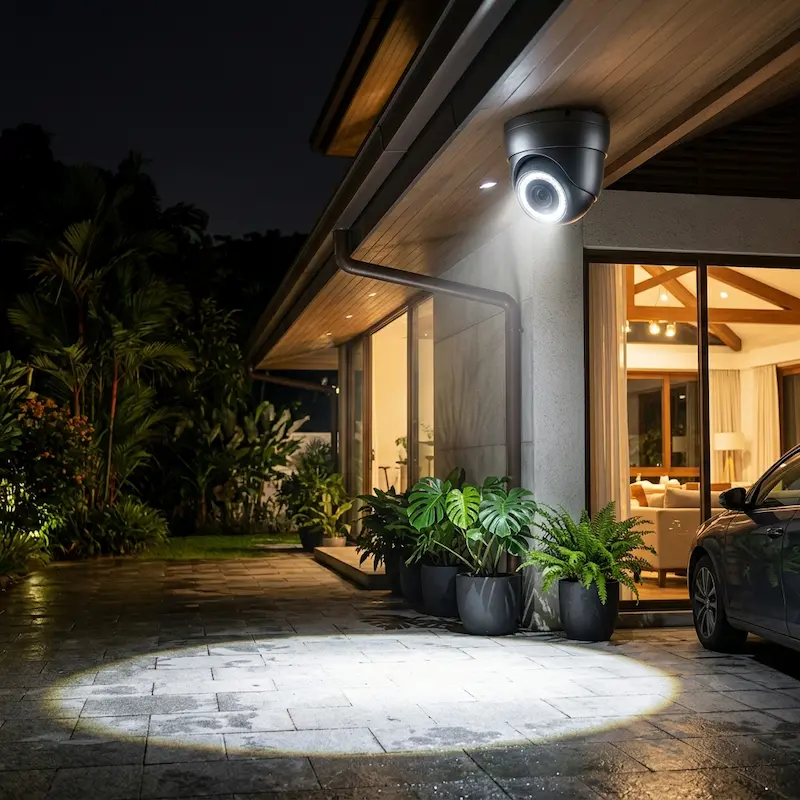
CCTV cameras on a landed home serve three distinct purposes: and the best installations cover all three. The first is deterrence: a visible camera at the gate, porch, and driveway tells anyone approaching that they are being recorded. The second is documentation: when something happens: a break-in attempt, a dispute with a contractor, an accident on the driveway: you have timestamped, high-resolution evidence. The third, and the one most families underestimate, is peace of mind: the ability to check on your property from anywhere, at any time.
For many households this third purpose is the most used daily. Parents watching young children play in the garden from the office. A family member checking on an aged parent in a granny flat. A homeowner reviewing the helper's routine during the day. A camera pointed at the front gate showing who is coming and going while the family is overseas.
Modern IP cameras have moved well beyond passive recording. Some Hikvision models include a built-in spotlight, microphone, and speaker. When motion is detected at the porch or driveway, the spotlight activates automatically: no one approaches in the dark. The built-in speaker can play a warning tone or let you speak directly to whoever is approaching, from your phone, in real time. This is active deterrence, not passive recording.
The Specification: We specify Hikvision IP cameras for most landed home installations. A typical 2–3 storey home needs 6–10 cameras covering the perimeter, driveway, gate, and key interior zones. Footage is stored on a local NVR; remote access via the Hikvision app from any device, anywhere.
What to consider:
- Exterior cameras need IP66 weatherproofing and strong IR night vision: Singapore's rainfall and humidity are demanding on outdoor equipment.
- For new builds, camera conduit and back-boxes should be installed at first fix: retrofitting cable through finished ceilings is expensive and disruptive.
- Consider spotlight cameras at the porch and driveway: the auto-illuminate function is one of the most practical features for daily residential use.
Video Intercom
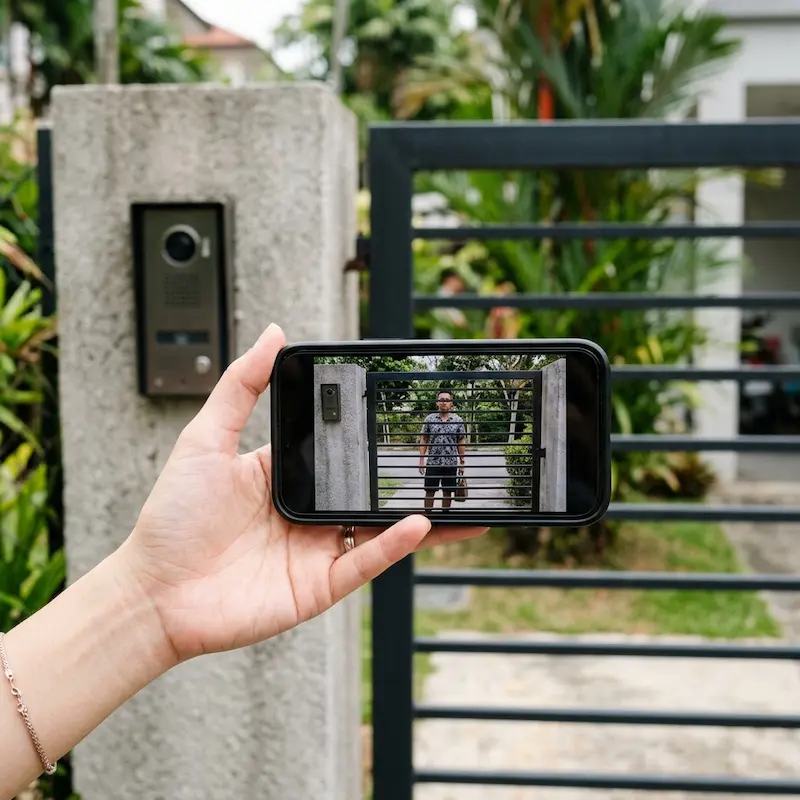
The intercom at your main gate is the system your household uses every single day. Not the alarm: the intercom. It is how visitors announce themselves, how deliveries are managed, how the helper and contractors are let in. For families with young children, an aged parent, or a helper managing the home during working hours, the video intercom is the primary daily security tool: and the one that most directly affects how convenient and safe the home feels.
A quality video intercom lets whoever is answering: at home, at the office, or overseas: see the visitor clearly, speak to them in real time, and release the gate with a single tap. No going downstairs, no shouting through a window, no relying on a helper to vet unknown callers.
We specify the Akuvox R25A for most landed home intercom installations. It is a compact IP video door phone with a 4MP fisheye lens giving a 150° field of view: wide enough to see the full front of a vehicle at the gate, not just the driver's face. IP65 weatherproofed, PoE-powered for a clean installation, with two independent relay outputs that can control both the main gate motor and a side pedestrian gate simultaneously from one device. Calls ring on indoor monitors, the Akuvox SmartPlus app on iOS and Android, or any SIP-compatible IP phone: answerable from anywhere.
Resident Access Too: Beyond visitor management, the Akuvox R25A supports RFID card and mobile credential access: residents can open the gate with a tap of their phone or access card without making a call. Two systems in one device: intercom for visitors, access control for residents.
What to consider:
- One R25A can control both the main vehicle gate and a side pedestrian gate via its two relay outputs: no second device needed if the gates are adjacent.
- For larger properties with a separate back gate or service entrance, a second R25A gives independent control at that point.
- For new builds: run Cat6 cable and power conduit underground from the gate pillar to the main house during construction: surface conduit on a finished gatepost is visible and vulnerable.
Auto Gate & Side Gate Automation
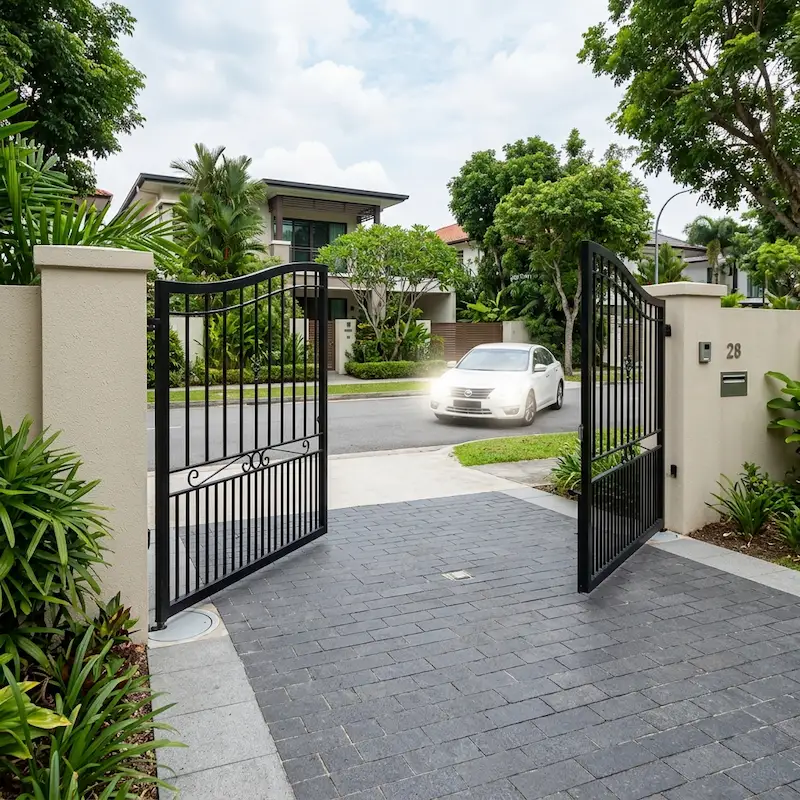
An automated gate is the most used piece of security equipment on a landed property. Every morning, every evening, every delivery, every visitor: the gate opens and closes dozens of times a day. Done well, it is invisible: the gate is open before you reach it and closed behind you without a thought. Done poorly, it is a constant source of inconvenience, service calls, and eventual replacement.
Beyond convenience, the automated gate is the physical barrier between your property and the street. When closed, it controls who can approach the house. When integrated with the intercom and CCTV, it becomes part of a system that lets you see, speak to, and decide on every visitor: from your phone, from anywhere in the world.
Swing Gate vs Sliding Gate
Singapore landed homes use two gate configurations. Swing gates open inward on hinges: the most common choice for residential driveways. For gate leaves under 2 metres wide, we use the MAG SW200P or Dormer concealed underground motor: the actuator sits below the gate pillar, completely hidden from view, giving the gate a clean architectural finish with no visible arm or mechanism. For gate leaves over 2 metres wide, the FAAC arm motor is the correct specification: mounted to the side of the gate, engineered for the additional weight and leverage of a wider leaf, rated for 24/7 duty cycle.
Sliding gates move horizontally along a track: chosen when driveway depth is limited or when the homeowner prefers the aesthetic. We use FAAC sliding gate motors for residential sliding gate installations. The key requirement is run-back space: the full gate width of clear space must be available alongside the driveway for the gate to retract into.
Upgrade Your Remote: YET402 WiFi Controller: Traditional remote keyfobs run on batteries, get lost, and occasionally trigger a neighbouring gate on the same frequency. We recommend upgrading to the YET402 WiFi 2-channel receiver: a compact device that fits inside the existing gate control panel, connects to your home WiFi, and works alongside your existing keyfobs with no replacement needed. It enables full gate control from the Tuya smart home app on any smartphone: open or close the gate from anywhere, check gate status remotely, and grant access without being home.
What to consider:
- Swing gate leaf under 2m: underground MAG SW200P or Dormer motor for the cleanest concealed finish.
- Swing gate leaf over 2m: FAAC arm motor: specify the model based on leaf width and weight.
- Sliding gate: confirm run-back space equals full gate width before specifying.
- Side and pedestrian gates: Viro electric lock released by the Akuvox intercom or a standalone keypad.
- For new builds: plan underground conduit from the gate pillar to the main electrical distribution before landscaping is laid.
Network Infrastructure & Whole-Home WiFi
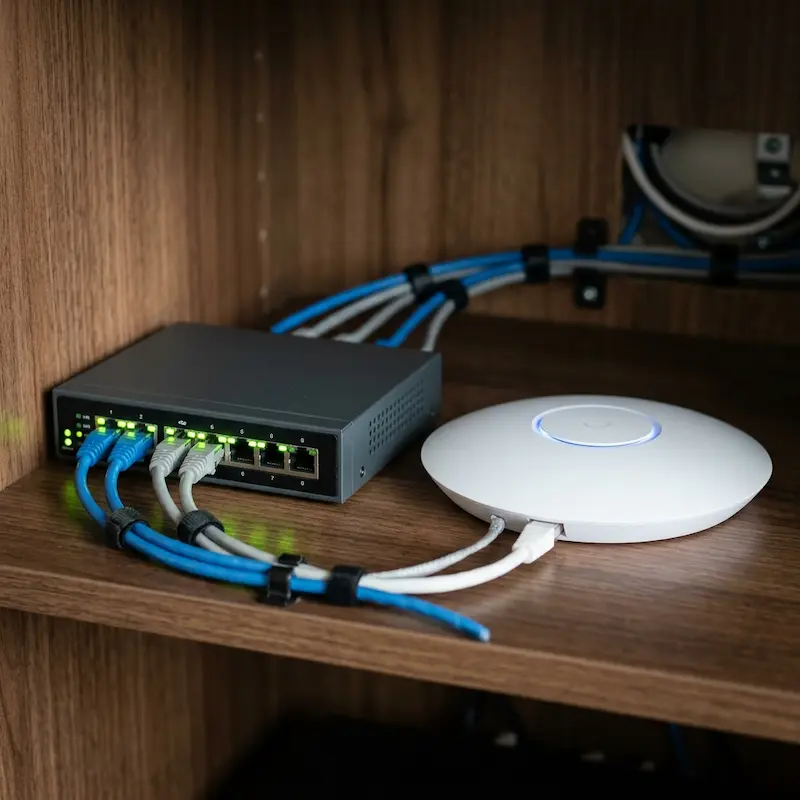
Every system on this page: the CCTV cameras, the IP intercom, the alarm app, the gate controller: runs over your home network. If the network is unreliable, all of them are unreliable. A dedicated, properly configured network is not an add-on to a landed home security system. It is the foundation everything else runs on.
A typical 2–3 storey Singapore landed home needs a managed PoE switch to power IP cameras and access points, and a set of ceiling-mounted WiFi access points: one per floor plus an outdoor unit for the garden, gate area, and driveway. Each access point is connected via Cat6 cable for maximum reliability and speed. Devices roam seamlessly between access points as you move through the home: the same WiFi network, full coverage, no dead zones.
This is the key difference between a proper installation and a DIY home mesh system: a professionally cabled, managed access point network does not degrade under load, does not introduce wireless interference for the cameras, and does not go offline when one node loses its wireless backhaul. Every device runs on a wired connection back to the switch.
The Specification: We carry two managed WiFi brands for landed home installations: TP-Link Omada and Ruijie Reyee. Both support WiFi 6, PoE-powered ceiling access points, seamless roaming between floors, and cloud-based management from a single app. Omada is the more widely deployed brand in Singapore; Ruijie Reyee offers comparable performance at a competitive price point. For the PoE switch that powers cameras, intercoms, and access points, we specify managed switches from the same ecosystem for VLAN separation between security and home data traffic.
What to consider:
- For new builds: run Cat6 cable to ceiling access point positions on every floor and to the outdoor access point location during first fix: it cannot be done cleanly after plastering.
- Separate your security camera network from your home WiFi using VLANs: prevents camera bandwidth from affecting streaming and browsing quality.
- An outdoor access point at the gate or garden area extends WiFi to the intercom, outdoor cameras, and gate controller: eliminating WiFi dead zones at the perimeter.
IP Phone & Internal Communications
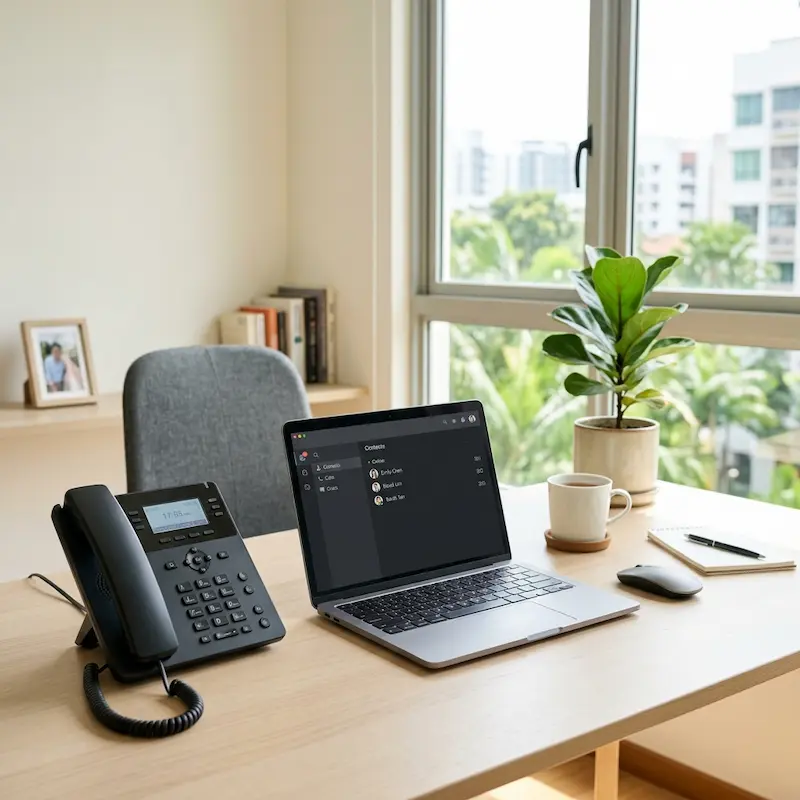
For larger landed homes: particularly those with domestic helpers, a granny flat, a home office, or multiple floors: an IP phone system replaces the traditional way of calling between rooms or from the gate. Instead of shouting between floors or relying on mobile phones for internal communication, an IP PBX gives every room or zone its own extension, all connected on the same system.
The practical use cases are everyday ones: the helper calls the homeowner's study from the kitchen extension to confirm lunch. A family member in the granny flat calls the main house. The gate intercom calls the home office directly when a visitor arrives. A home office extension receives calls on the same number as the office, with the homeowner's mobile as a backup if the desk phone is unanswered.
For homeowners who run a business from home or need a professional main number for their property, a Yeastar IP PBX with Singtel SIP trunking replaces PSTN hunting lines: lower monthly cost, same number portability, and a Linkus mobile app that turns any smartphone into a full office extension from anywhere in the world.
The Specification: We specify the Yeastar S-Series IP PBX for most landed home and home office installations: straightforward to manage, supports SIP trunking from Singtel, and includes the Linkus UC app for iOS and Android. Handsets are Fanvil or Yealink desk phones, PoE-powered and auto-provisioned from the Yeastar portal. For most homes, a 4–8 extension system is sufficient; larger properties with multiple zones can scale the same platform.
What to consider:
- Not every landed home needs an IP phone system: it is most relevant for larger homes with helpers, granny flats, or home office use.
- The Yeastar Linkus app on your mobile means calls to your home or office number reach you anywhere: without giving out a personal number.
- Akuvox intercom panels register as SIP extensions on the Yeastar PBX: a visitor call at the gate rings your desk phone and your mobile simultaneously.
How They Work Together
These six systems do their jobs independently. But they are most useful when coordinated. A visitor presses the intercom at the gate: the Akuvox R25A calls your phone, showing you the full gate view from the fisheye camera. You speak to the visitor, confirm who they are, and release the gate with a tap: which the CCTV captures and timestamps automatically.
If someone approaches the house at 2am without going through the gate, the alarm's PIR detector triggers, the external siren fires, and the CCTV sends you a motion alert with a direct link to the relevant camera feed. Every system doing its job: in sequence: as a complete picture of your home, from anywhere.
The Brands Behind the Systems
Hikvision
IP cameras and NVR storage: with AI analytics, spotlight, and built-in speaker options for active home deterrence.
View Specification →RISCO
Wired and wireless burglar alarm systems: PIR, door contacts, glass break sensors, external siren, and app alerts.
View Specification →Akuvox R25A
4MP fisheye video intercom with 150° field of view, dual relay outputs, RFID access, and SmartPlus mobile app.
View Specification →FAAC
Italian arm motors for swing and sliding gates over 2m per leaf: 24/7 duty rated and well-established in Singapore.
View Specification →MAG & Dormer
Concealed underground swing gate motors for gate leaves under 2m: completely hidden from view for a clean architectural finish.
View Specification →YET402 WiFi
WiFi 2-channel gate controller: adds smartphone control via the Tuya app to any existing gate system without replacing the remote keyfobs.
View Specification →Omada & Ruijie
Managed PoE switches and WiFi 6 ceiling access points: whole-home coverage with VLAN-separated security and home data networks.
View Specification →Yeastar
IP PBX with Linkus mobile app: home and office extensions on one system, SIP trunking from Singtel, and Fanvil or Yealink desk phones.
View Specification →Ready to Secure Your Home?
Book a site assessment: we will visit your property, walk every entry point, and design a system that fits how your household actually lives.
Serving Singapore Since 2006