Vehicle Access Systems

Automate Vehicle Entry. Eliminate Bottlenecks.

Vehicle access is not just about barriers. It is about managing flow, reducing manpower, and improving entry efficiency.

Engineered for Singapore Properties Since 2006

Police Licensed | | Sites Protected

In Short

Vehicle management combines three systems: Licence Plate Recognition (LPR) cameras that read number plates automatically, barriers that physically control entry, and intercoms that manage visitors and exceptions. LPR handles recognised vehicles without stopping them. Barriers control the physical gate. Intercoms handle everything the system cannot decide alone; contractors, unregistered visitors, deliveries. Together they improve traffic flow at peak hours, reduce the manual workload on guards, and create a complete, searchable record of every vehicle that enters or exits the property. The barrier is the most visible part of the system. It is rarely the most important part.

Three Systems. One Gate.

Vehicle Access Is Not One Thing: It Is Three

A complete vehicle access system has three layers working together; a recognition layer that identifies vehicles automatically, a barrier layer that physically controls entry and exit safely, and a communication layer that handles vehicles the system cannot identify on its own. Each layer is essential. Remove one and you create a gap.

LPR & Vehicle Recognition: GantryGo

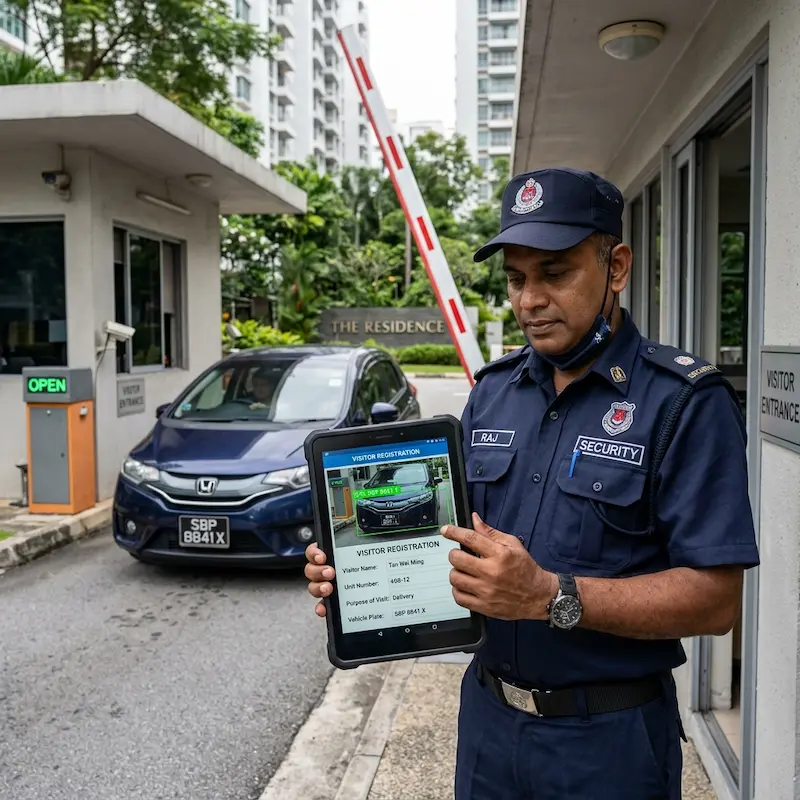
GantryGo is Securevision's own cloud-based vehicle management platform. LPR cameras at the entry and exit lanes read licence plates in under a second; matching against resident, season, and pre-registered visitor lists. The system runs on desktop and tablet at the guardhouse, giving operators a live view of every vehicle movement, full entry logs, and remote management access from anywhere.

Barriers & Gate Hardware: FAAC & MAG

The physical layer; car park barriers and auto-gates that open and close in response to signals from GantryGo or the guardhouse intercom. We carry two car park barrier brands: FAAC from Italy and MAG; both specified for 24/7 duty cycle reliability and fast arm opening speeds that prevent queue build-up at peak hours. Safety is built in at every lane: photocells, LiDAR sensors, and loop detectors ensure the barrier never closes on a vehicle or pedestrian.

Guardhouse Intercom: Akuvox R20A

LPR handles vehicles it recognises. The Akuvox R20A handles everything else. Mounted at the guardhouse or lane entrance, the R20A provides two-way HD video and audio between the driver and the guard or remote operator, who can see the vehicle clearly, speak to the driver, and release the barrier with a single tap from the guardhouse workstation, a tablet, or a phone anywhere on the network. Unknown visitors, contractors, and ad-hoc deliveries are handled cleanly without breaking the automated flow for everyone else.

System 1 of 3: LPR & Vehicle Recognition

GantryGo: Built by Securevision for Singapore Properties

GantryGo is our own cloud-based vehicle management platform; developed from years of on-the-ground experience installing and maintaining vehicle access systems across condominiums, industrial sites, and commercial properties in Singapore. It is not off-the-shelf software adapted for local conditions. It was built for them.

Manual Guard Logging

  • Guard manually records plate number and purpose of visit
  • Significant queue build-up at 8am and 6pm peak hours
  • Handwritten logs; difficult to search, audit, or share
  • Accuracy depends entirely on guard alertness
  • No automatic blocking of blacklisted or overstay vehicles
  • No remote visibility; management cannot see entry logs in real time

GantryGo: Automated LPR

  • LPR camera reads the plate in under 1 second; barrier opens automatically
  • Residents, season parking, and pre-registered visitors flow through without stopping
  • 100% digital log; searchable by plate, date, time, or vehicle type
  • Blacklist enforcement; flagged plates trigger an alert and barrier hold
  • Visitor pre-registration; residents invite guests via app; GantryGo handles the rest
  • Cloud-based; management views live entry logs and reports from any device

What GantryGo Manages

GantryGo handles three vehicle categories at every entry point: residents and season parking holders (fully automated, no stop required), pre-registered visitors (verified against the invite list, barrier opens automatically), and unregistered vehicles (held at the barrier and routed to the guardhouse intercom for manual verification). Guards shift from data-entry to exception-handling; managing the 5% of vehicles the system flags, rather than processing the 95% it handles automatically.

System 2 of 3: Barriers & Safety

The Physical Layer: Built for 24/7 Operation

The barrier is the most mechanically demanding component in the system; opening and closing hundreds of times a day, in all weather conditions, with vehicles and pedestrians in close proximity. Specifying the right barrier for the site traffic volume and lane width is as important as the software running it.

Undersized or Poorly Specified Barriers

  • Duty cycle mismatch; barrier motor overheats at peak-hour volumes
  • Slow arm speed creates queue build-up and driver impatience
  • No safety sensors; barrier closes on vehicles causing arm strikes and damage
  • Frequent breakdowns; high service cost and resident complaints
  • Cannot integrate with LPR or access control; manual operation only
  • No battery backup; power failure means manual override at the lane

Correctly Specified FAAC & MAG Barriers

  • Models designed to operate continuously throughout the day; no overheating, no downtime
  • Fast arm opening: FAAC models open in as little as 2 seconds
  • Integrated safety; photocells, LiDAR, and loop detectors on every lane
  • Choice of FAAC or MAG barriers; both specified for Singapore conditions and compatible with GantryGo
  • Full integration with GantryGo; barrier responds to LPR signals automatically
  • Battery backup; barrier continues operating during power interruptions

Safety Is Not Optional

Every barrier lane we install includes three layers of safety detection. Photocells beam across the lane at bumper height, if the beam is broken while the arm is closing, the barrier stops and reverses immediately. LiDAR sensors, which use laser measurement to detect vehicles and obstacles; provide a wider detection zone above the vehicle, catching tall loads, motorcycles, and pedestrians that photocells might miss. Loop detectors embedded in the road surface confirm vehicle presence before opening and prevent the arm closing while a vehicle is still in the lane. These are not upgrades; they are standard on every installation.

Barrier Hardware We Specify

Two Brands. Different Roles.

We specify FAAC for car park barriers and MAG for long-range UHF resident access; each chosen for reliability, local parts availability, and compatibility with GantryGo.

System 3 of 3: Guardhouse Intercom

The Human Layer: For Everything the System Cannot Decide Alone

Automation handles the predictable. The intercom handles everything else; the contractor who was not pre-registered, the visitor whose plate was keyed in incorrectly, the delivery driver at an unexpected hour. The Akuvox R20A sits at the lane entry point and routes unrecognised vehicles to a guard or remote operator who can see, speak, and decide.

No Intercom: Guard-Dependent Manual Entry

  • Guard must physically walk to the lane for every unrecognised vehicle
  • No visual of the driver from the guardhouse; guard goes in blind
  • Cannot handle exceptions when guard is attending to another matter
  • No record of the conversation or the decision made at the lane
  • Remote management impossible; manager must be on-site to intervene

Akuvox R20A: Video Intercom at the Lane

  • Driver presses the call button; guard's screen shows HD video of the vehicle and driver
  • Two-way audio; guard speaks to the driver without leaving the guardhouse
  • Remote barrier release; guard taps to open from the workstation, tablet, or phone
  • Call forwarding, if the guard is occupied, the call routes to the next available operator
  • Full call log; every intercom event recorded with timestamp and outcome
  • Remote management; facility manager can answer calls and release barrier from anywhere

Where the R20A Fits in the System

The Akuvox R20A is mounted at the entry lane, weatherproofed to IP65, and connected over the same IP network as GantryGo and the barrier controller. When GantryGo does not recognise a plate, the barrier holds and the R20A prompts the driver to call the guardhouse. The guard sees the vehicle on screen, verifies verbally, and releases the barrier; all without leaving the workstation. The entire interaction is logged in GantryGo alongside the automated entries, giving management a complete picture of every vehicle that passed through the gate.

Operational Reality

How All Three Systems Work in Real Life

These scenarios show how GantryGo, the barrier, and the intercom handle the full range of vehicle types at a typical condominium or commercial property.

Resident Returns Home: Fully Automated

The LPR camera reads the resident's plate as the vehicle approaches. GantryGo confirms the match in under a second and sends the open signal to the barrier. The arm is already rising as the vehicle reaches the lane; no stopping, no window winding, no interaction required. Entry logged automatically.

Pre-Registered Visitor Arrives: Automated

A resident pre-registered their guest's plate in GantryGo the night before. The LPR camera reads the plate as the visitor pulls up. GantryGo verifies it against the invite list and opens the barrier; no guard interaction, no call needed. The visit is logged with entry time and plate image.

Unregistered Contractor: Intercom Handled

A contractor arrives unannounced. GantryGo does not recognise the plate; the barrier holds and the R20A panel prompts the driver to call the guardhouse. The guard sees the van on screen, speaks to the driver, calls the unit to confirm, and releases the barrier with a tap. The interaction is logged in full.

Blacklisted Vehicle: Automatic Hold

A vehicle previously flagged for a parking violation attempts entry. GantryGo matches the plate against the blacklist, holds the barrier, and sends an alert to the guard's screen. The guard handles it without the vehicle ever entering. The attempt is logged with timestamp and plate image.

System Capabilities

What the Full System Enables

Plate Recognition at Speed

LPR cameras typically read Singapore plates within seconds as vehicles approach the lane; accurate in low light and rain, with recognition rates that improve when plates are clean and approach speed is moderate. No stopping required for resident and pre-registered vehicles.

Resident & Visitor Management

Residents manage their own vehicle profiles and pre-register guests through the GantryGo resident portal; no guard involvement needed for routine visitor access.

Digital Entry Logs

Every vehicle movement logged with timestamp, plate image, and entry method; searchable and exportable for incident investigation or compliance reporting.

Blacklist & Alert Management

Flagged plates are held automatically at the barrier with an instant alert to the guard; no dependence on guard memory or attention to prevent unauthorised entry.

Remote Management

GantryGo is cloud-based; facility managers and managing agents can view live entry logs, run reports, and manage vehicle records from any device, anywhere.

Safety-First Lane Design

Photocells, LiDAR sensors, and loop detectors on every lane; the barrier never closes on a vehicle or pedestrian. Safety compliance built into every installation.

A Practitioner Observation

Most vehicle access delays occur because people need to make decisions at the lane; is this vehicle authorised? Should I let this contractor in? What is this delivery van doing here? Automation works best when those decisions are made before the vehicle arrives. Resident white-listing, visitor pre-registration, and contractor booking are not features of the software; they are the operational habits that determine how effective the system actually is on the ground.

The Architecture

Part of a Larger Security Architecture

Vehicle access manages the front gate. Premises security monitors the perimeter. Entry access controls who moves through the building. The platform coordinates everything from one operational view.

Connected Intelligence

How Vehicle Access Works With Other Systems

  • LPR linked to CCTV: When a vehicle enters or triggers an alert, the relevant camera feed is pulled up automatically on the guard's monitor; the guard sees the vehicle in full context, not just the plate image.
  • Credentials sync with pedestrian access: Resident vehicle records in GantryGo can be aligned with their pedestrian access credentials; one resident profile across both the car park barrier and the lobby access system.
  • Intercom logs in GantryGo: Every R20A guardhouse call is timestamped and linked to the corresponding vehicle entry event; management has a single complete record regardless of how entry was granted.
  • Managed via platform: VESTA or HikCentral can display barrier status, live LPR feeds, and active intercom calls in one dashboard; the guard and management team see the full gate picture without switching between systems.
Learn more about Platform & Management →
GantryGo vehicle management dashboard and barrier system
From Real Projects

Common Mistakes We See

Most vehicle access problems are not caused by the barrier or the camera. They are caused by how the system was specified and how the workflow was designed around it.

Replacing the Barrier When the Real Problem Is Visitor Management

Many MCSTs and facility managers assume the barrier is the bottleneck. In most cases, the real issue is the visitor management process; how unregistered vehicles are handled, how contractors get authorised, and how residents invite guests. A new barrier installed on top of a broken manual verification process creates a faster version of the same problem. We assess the operational workflow before specifying any hardware; because the right answer is sometimes a process change, not a barrier replacement.

Choosing the Fastest Barrier Instead of the Right Barrier

Arm opening speed gets disproportionate attention in barrier specifications. A 2-second barrier arm opening is useful. A correctly sized duty cycle for the site's daily vehicle volume is essential. A barrier motor that overheats after 200 daily cycles in a site doing 500 daily cycles will cause more disruption than a slightly slower arm. We specify barriers based on daily cycle count and lane traffic patterns, not on which model has the most impressive spec sheet headline.

Skipping Safety Sensors to Reduce Cost

Safety sensors; photocells, LiDAR, and loop detectors; are sometimes treated as optional extras in a barrier specification. They are not. A barrier that closes on a vehicle causes damage, creates liability, and damages the property's relationship with residents and visitors. In Singapore, barrier arm strikes are the most common cause of car park management disputes. We include safety sensors as standard on every installation. The cost of a sensor is always less than the cost of one insurance claim.

Treating LPR as a Perfect System

Licence plate recognition is highly accurate under good conditions; clean plates, moderate approach speed, adequate lighting. It is not infallible. Dirty plates, non-standard characters, and vehicles approaching at steep angles all reduce recognition confidence. This is exactly why the intercom layer matters. A system designed around the assumption that LPR will work every time will fail operationally the first time it does not. Every lane should have a clear fallback; an intercom that routes the unrecognised vehicle to a guard who can see, speak, and decide.

A Practitioner Observation

A barrier controls vehicles. It does not provide perimeter security on its own. A determined driver can go around a barrier, tailgate through an open one, or simply wait for someone else to open it. The value of a vehicle access system is not that it is physically impenetrable; it is that it logs every vehicle, flags exceptions, reduces guard workload, and makes the management of a large property operationally practical. The security layer comes from the camera records, the blacklist enforcement, and the workflow, not the barrier arm.

Planning Considerations

What Affects the Cost of a Vehicle Access System?

Vehicle access costs vary significantly by lane count, civil works, and system integration requirements. Understanding the key drivers helps set realistic expectations before the site assessment.

Number of Lanes

Each lane requires a barrier, an LPR camera, safety sensors, and cabling; so lane count is the primary cost multiplier. A single entry and single exit lane is the minimum configuration for most condominiums. Separate lanes for residents and visitors, dual entry lanes for peak-hour flow, and pedestrian gates each add scope and cost. The number of lanes also determines the GantryGo licence tier required.

Barrier Type and Duty Cycle

Barriers are specified by duty cycle; the percentage of the day the motor can operate without overheating. A residential barrier at 50% duty cycle costs significantly less than a 100% duty cycle commercial-grade unit. Sites with high daily cycle counts; condominiums with 500+ movements per day; require heavy-duty barriers. Specifying a barrier below the required duty cycle is the most common cause of early failure and repeat maintenance calls.

Civil Works

Civil works; barrier foundation pads, conduit laying, electrical supply to the lane, and road loop detection installation; are often the largest single cost item in a new vehicle access installation. For replacements on an existing foundation, civil costs are minimal. For new installations or lane extensions, civil scope must be confirmed before the project is quoted; the ground conditions, existing infrastructure, and town council approval timelines all affect cost and programme.

LPR Camera Count and Position

Each lane typically requires one entry and one exit LPR camera, plus a guardhouse overview camera. Camera count increases with the number of lanes and with additional capture points for complex lane layouts. Overhead LPR cameras (for wider lanes and multi-lane entries) are more expensive than standard lane-side positions. Lighting infrastructure at the capture point: IR illuminators for night reading; may be required where ambient lighting is inadequate.

Visitor Management Requirements

Basic visitor management; an intercom at the lane and manual guard verification; adds minimal cost. Full visitor pre-registration via GantryGo resident portal, integration with a condominium management platform (VESTA), and QR code visitor passes add software configuration and integration scope. For MCSTs requiring resident self-service visitor management through a mobile app, the resident onboarding process (generating accounts, communicating to residents) is a project management cost that should not be underestimated.

Integration with Other Systems

GantryGo integrating with CCTV for automatic camera pop-up on vehicle events, with VESTA for resident credential alignment, or with pedestrian access control for a unified resident identity profile; each integration adds configuration scope. Integrations are significantly more cost-effective when scoped during the original project than when added as retrofits after the system is live.

Can Existing Barriers Be Reused?

Sometimes. Whether existing barriers can be retained depends on three factors: age and condition of the barrier motor (FAAC and MAG units have service lives of 7–12 years under typical Singapore conditions), availability of spare parts from the manufacturer, and whether the barrier has an accessible relay output that GantryGo can trigger. Many projects retain the existing barrier structure and foundation while replacing only the motor, controller, and safety sensors; significantly reducing civil costs. We assess reuse feasibility during the site survey and provide a specific recommendation, not a generic answer.

Is This Right for You?

Who Vehicle & LPR Management Is For, and When to Start

Vehicle access automation is a significant operational upgrade. Here is an honest guide to when it makes sense, and what to consider before you commit.

This Is For You If…

  • Your condominium, commercial building, or industrial site has a car park with 30 or more resident or authorised vehicles; manual IU or remote ticketing is creating queues and guard workload
  • You are an MCST or Managing Agent dealing with recurring unauthorised parking, visitor overflow, or contractor vehicle management
  • Your guardhouse is staffed 24 hours and you want to reduce the manual workload on guards at peak entry and exit times
  • You are building a new development and want barrier, LPR, and intercom infrastructure designed in from the start
  • Your existing barrier or LPR system is more than 7 years old and parts or support are becoming difficult to source
  • You have had incidents involving unauthorised vehicles, tailgating through the barrier, or disputes at the guardhouse

You May Not Need This Yet If…

  • Your property has fewer than 20 vehicles and a permanently staffed guard; manual management remains practical and cost-effective at this scale
  • Your primary concern is pedestrian access, not vehicle flow; access control and intercom address that separately
  • You are looking for a short-term solution during construction or a temporary event; portable barriers without LPR are more appropriate

GantryGo: Built for Singapore Properties

GantryGo is Securevision's own LPR-based vehicle management platform, developed specifically for Singapore condominiums and commercial properties. It handles resident white-listing, visitor pre-registration, and guard console management from a single interface. A demo can be arranged as part of any site assessment.

Our Process

How We Work With You: From Assessment to Live Operation

Vehicle access systems involve civil, mechanical, and software elements. Our process ensures each layer is designed together, not assembled piecemeal.

  1. Site Assessment

    We assess the entry and exit lanes; width, kerb height, overhead clearance, existing barrier positions, guardhouse layout, and cable routing. We measure LPR camera sightlines and lighting conditions at the capture point. For retrofits, we check whether existing civil works (foundation, conduit) can be reused.

  2. System Design & Proposal

    We specify barrier model and boom length, LPR camera positions and mounting heights, intercom station layout, and GantryGo or third-party software configuration. Civil and electrical work scope is included. You receive a full breakdown, not a per-item list without context.

  3. Civil & Mechanical Works

    Barrier foundation, conduit laying, and electrical supply are coordinated with your site contractor or managed by us directly. We ensure barrier placement meets Lane Traffic Control requirements and does not obstruct pedestrian flow.

  4. Installation & Commissioning

    Barriers, LPR cameras, intercoms, and software are installed and commissioned together. White-listing of resident vehicles is completed before go-live. Guard console training is conducted on-site.

  5. Handover & Ongoing Support

    Management staff and guards are trained on the GantryGo console; adding vehicles, managing visitor access, and reviewing entry logs. Maintenance contracts cover annual servicing of barrier motors and safety loops, which are mechanical components with wear schedules.

What to Prepare Before the Assessment

  • Number of resident vehicles and approximate daily visitor vehicle volume
  • Current method of vehicle authorisation: IU, remote, guard manual check
  • Whether you have an existing barrier and its brand and age
  • Lane dimensions; single or dual entry, lane width
  • Whether guardhouse has existing network connectivity

Typical Timeline

Barrier and LPR replacement on an existing foundation: 2–4 weeks. New installation with civil works: 6–10 weeks from proposal approval, depending on civil contractor scheduling and town council approvals where required.

Solving a Specific Problem?

These pages address common vehicle and visitor challenges that LPR and barrier systems directly resolve:

Common Questions

Frequently Asked Questions: Vehicle & LPR Management

What is LPR and how does it work?

LPR stands for Licence Plate Recognition. LPR cameras use a combination of infrared illumination, high-shutter-speed imaging, and image processing software to read vehicle number plates automatically as vehicles approach the lane. In Singapore, where plates follow a consistent format, recognition rates are high under normal conditions. The plate number is matched against a database of authorised vehicles; residents, season parking, pre-registered visitors, and the barrier signal is triggered automatically if a match is found.

How accurate is LPR?

Under good conditions; clean plates, moderate approach speed, adequate lighting; recognition accuracy is typically above 95%. Recognition confidence decreases with dirty or damaged plates, non-standard characters, severe approach angles, or vehicles approaching too fast. This is why every vehicle access system should include an intercom as a fallback; unrecognised vehicles are routed to a guard who can verify manually. A system designed around perfect LPR accuracy will fail operationally when conditions are less than ideal.

Can LPR work in the rain or at night?

Yes. LPR cameras are designed for outdoor operation and use infrared illumination that is not affected by rain or darkness. Singapore's frequent rain events do not significantly affect recognition performance; the camera's IR illuminator lights the plate regardless of ambient conditions. Very heavy downpour that physically obscures a dirty plate may reduce confidence slightly, but under normal Singapore weather conditions, LPR operates reliably at any hour.

What happens if a plate is not recognised?

The barrier holds and the driver is prompted to use the intercom at the lane; either a dedicated call button or an Akuvox R20A panel. The guard at the guardhouse receives the call, sees the vehicle on screen via HD video, speaks to the driver, verifies the visit, and releases the barrier with a tap. The interaction is logged alongside all other vehicle entries. The intercom is not a backup; it is a designed part of the system for handling the vehicles that LPR is not intended to process automatically.

Can visitors be pre-registered for vehicle access?

Yes. GantryGo allows residents to pre-register visitor vehicle plates through the resident portal; the visitor's plate is added to the approved list for a specific date and time window. When the visitor arrives, the LPR camera reads the plate, matches it against the pre-registered list, and opens the barrier automatically; no guard interaction required. The visit is logged with entry time and plate image. For properties without resident self-service, guards can add visitor plates directly at the guardhouse console.

What is the difference between LPR and UHF transponder tags?

UHF (Ultra High Frequency) tags are small electronic transponders attached to the vehicle windscreen; the reader detects the tag at long range, typically 5–10 metres, allowing vehicles to pass through at moderate speed without stopping. LPR reads the existing number plate without any device fitted to the vehicle. LPR is generally preferred for visitor and contractor management because it requires no pre-installed tag. UHF is preferred where very high throughput is needed or where the vehicle population changes frequently and plate-based management is impractical. Both can be used simultaneously in the same lane.

Can existing barriers be integrated with a new LPR system?

Often yes. Most barriers have an accessible relay input that can be triggered by an external signal from GantryGo. If the existing barrier is in good condition and the manufacturer is still supporting the model with spare parts, the barrier mechanism can often be retained while only the controller, LPR camera, and safety sensors are replaced; significantly reducing the project cost. We assess reuse feasibility during the site survey and provide a specific recommendation based on barrier age, condition, and integration capability.

Can vehicle access integrate with pedestrian access control?

Yes. Resident vehicle records in GantryGo can be aligned with pedestrian access credentials in the access control system; a single resident identity across both the car park barrier and the lobby access reader. When a resident's access is revoked (e.g. tenant moves out), both systems can be updated together. VESTA integrates both layers under one estate management platform, giving managing agents a single point of management for resident vehicle and pedestrian access.

How many vehicles can GantryGo manage?

GantryGo is cloud-based and scales with the property. There is no hard limit on the number of registered vehicles or visitor records; the platform is designed for condominiums and commercial properties ranging from 50 to several hundred resident vehicles plus visitor volume. The practical limit for any given installation is lane capacity and barrier cycle count, which are physical, not software, constraints. For very large developments with multiple entry points, GantryGo supports multi-lane and multi-entry configurations from a single cloud account.

Do I need a town council permit for a car park barrier in Singapore?

For HDB estates and properties with shared driveways or roads, approval from the relevant authority: HDB, town council, or LTA depending on the road classification; may be required before barrier installation. For private developments on private land, no external permit is typically required, though building management consent and MCST approval under BMSMA may apply. We advise on the approval process based on your specific property and coordinate the necessary submissions where required as part of the project scope.
Go Deeper

More Resources on Vehicle & LPR Management

Ready to Secure Your Property?

Tell us about your site. We'll assess it and design a system that works as one.

Police Licence · Serving Singapore Since 2006