Managed Living Security Has One Core Brief: Know Who Is In Your Property at All Times.
Dormitory, co-living, or managed hostel: the brief is the same: know who is in your property at all times and prove it with compliance records.
Securing Singapore managed living properties since .
In Short
Every Person in the Property Accounted For: Without a Permanent Staff Presence
Managed living properties face a challenge that residential buildings and commercial offices do not: high resident turnover, frequent and unscheduled visitors, and the need to maintain accountability across the property without permanent on-site staff. Access control, visitor management, CCTV, and intercom systems work together to ensure authorised access, maintain accurate records, and provide operators with visibility across the property from any location.
The security system in a managed living property is not a support function: it is the operational infrastructure that makes the property manageable at all. A property manager overseeing a co-living building of 40 rooms from a central office cannot visit every time a resident checks in, checks out, or has a visitor. The system manages the routine operational tasks automatically, leaving the manager to handle the exceptions: not the rule.
Residents, Visitors, and Access: Across a High-Turnover Population.
Managed living properties share a security brief that commercial and residential buildings do not face in the same way: the resident population turns over frequently, the visitor population is high and unscheduled, and the operator often needs to manage credentials, monitor movement, and respond to incidents without permanent on-site staff. The security system is not a support function: it is the operational infrastructure that makes the property manageable at all.
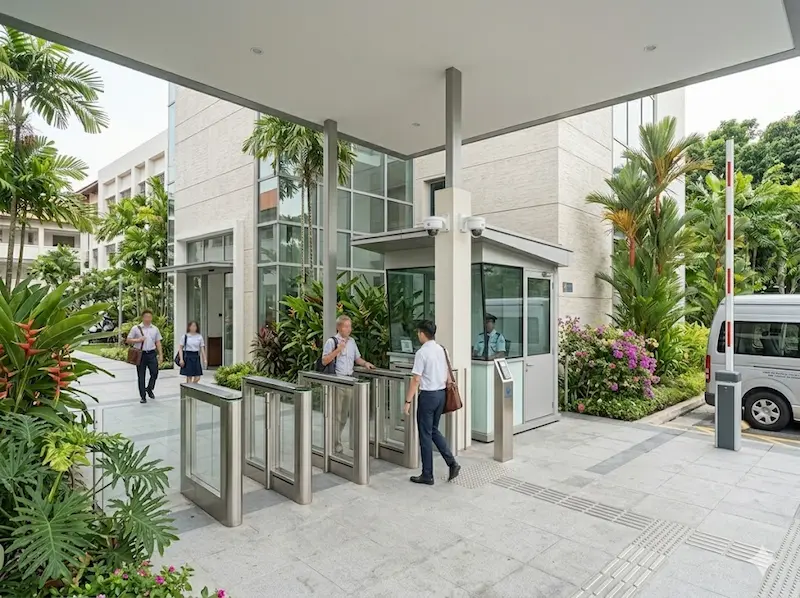
The three environments covered in this guide: worker dormitories, co-living apartments, and managed hostels: each solve the same fundamental problem in different ways, at different scales, and under different regulatory obligations. A worker dormitory handles thousands of daily movements with MOM compliance requirements and a professional guard team. A co-living property handles weekly resident turnover with a remote operator and no front desk. A managed hostel handles mixed short-stay and long-stay residents sharing common facilities. The systems that serve each one are different: but the principle is the same: every person in or entering the property should be accounted for, and every access event should be on record.
Common Mistakes We See in Managed Living Security Projects
After reviewing worker dormitories, co-living properties, and managed hostels across Singapore, several operational and design mistakes appear repeatedly.
Treating Managed Living Like Traditional Residential
A traditional residential building has a stable resident population, low visitor turnover, and a long-term relationship between residents and the property. Managed living has none of these. A co-living property with weekly check-ins and check-outs, a worker dormitory with thousands of resident movements daily, and a managed hostel with a mix of short-stay and long-stay residents all require a completely different security architecture from a private condominium or an HDB block. The most common failure is applying a traditional residential access control model: a physical key, a single building entry card: to a managed property environment where that model breaks down within weeks.
Relying on Physical Keys
Physical keys create two operational problems in managed living environments: the administrative burden of tracking, distributing, and recovering them across a high-turnover population; and the security gap created every time a key is not returned. A co-living resident who does not return their key at check-out has, in effect, retained indefinite access to the building until the lock is changed: which is a cost and a delay. Digital credentials: card, PIN, or mobile: can be revoked instantly when a tenancy ends, with no physical recovery required and no lock change needed. The operational and security case for digital credentials in any managed living environment is overwhelming.
No Structured Visitor Accountability
Visitors at managed living properties are inevitable and welcome: but they need to be logged. The most common visitor management failure is a combination of a paper sign-in book at the entrance and a buzzer intercom that admits anyone a resident chooses to buzz in, without any log of who was admitted, by whom, or for how long. This leaves the operator with no record of who has been in the building beyond the resident population: a gap that becomes significant in any incident investigation and a compliance failure for dormitory operators with MOM visitor logging obligations.
Running Multiple Standalone Systems with No Unified View
A managed living property that has its access control, intercom, and CCTV from three different vendors, on three different platforms, with three different apps, gives the operator three partial pictures of what is happening in the property rather than one complete one. The operational cost of managing separate systems is significant: and the gap between them is where accountability failures occur. When an incident needs investigation, the operator has to cross-reference access logs, footage, and visitor records from three sources. A unified platform that combines all three gives the operator a single searchable record and a single dashboard view.
A Practitioner Observation
The most consistent finding in managed living security assessments is that the operator's existing system was designed for a smaller, simpler, or more stable environment than the one it is currently managing. A system that was adequate when the property had 20 rooms and a permanent front desk is often not adequate when it has 80 rooms and is managed remotely. The assessment we conduct at the start of every project is not primarily about whether the hardware is current: it is about whether the system design still matches the operational model.
Worker Dormitories & Managed Worker Housing
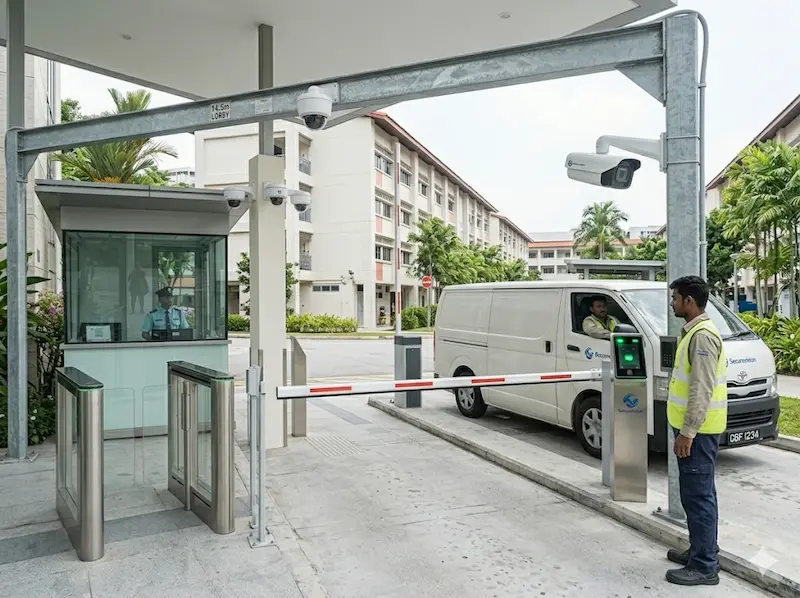
A large worker dormitory in Singapore: some housing thousands of workers across multiple blocks: is one of the most operationally demanding access control environments in the country. Shift changes produce concentrated movement spikes at entry and exit points several times a day. MOM compliance requires a real-time record of who is on-site at any given moment. Visitor and contractor access needs to be managed separately from the resident population. And the guard team, however capable, cannot process thousands of individual entry events manually without creating bottlenecks that disrupt the operations of every employer whose workers live on-site.
The entry system at a large dormitory uses a combination of facial recognition and LPR cameras at the main gantry to process the resident population at pace. A registered worker approaches the gantry: their face is matched against the enrolled database in under a second, the barrier opens, and the entry event is logged with the individual's identity, unit, employer, and timestamp. No card to present, no reader to touch, no guard to check against a list. During peak shift-change windows, this throughput advantage is the difference between a smoothly managed entry flow and a queue that backs up onto the public road. LPR cameras at the vehicle entry lane simultaneously process authorised vehicles: employer buses, contractor transport, site vehicles: logging each movement against the site record. The same platform manages visitor access separately: visitors register at a guardhouse terminal with their NRIC and the resident or employer they are visiting, receive a time-limited pass, and are logged as a distinct visitor category in the movement record.
CCTV covers the full site perimeter, all residential block entrances, common facilities, and the guardhouse: with AI analytics on key cameras detecting loitering at block entrances after quiet hours, overcrowding at common area access points during peak periods, and perimeter fence anomalies. For emergency mustering: fire evacuation, medical incident, MOM compliance check: the VESTA platform provides a live headcount of everyone on-site from the access control log, without a manual roll-call across multiple residential blocks. The intercom at the main pedestrian entrance and each residential block entrance uses an IP video call panel: visitors announce themselves to the guardhouse, which can see them on the video stream and release the gate from the guardhouse workstation. Managed PoE switches throughout the site carry the LPR cameras, access controllers, CCTV, and guardhouse workstations on a single managed network.
MOM Compliance From the Access Log: MOM reporting requirements for large dormitories include real-time or near-real-time occupancy records and visitor logs. The VESTA platform generates these reports directly from the access control and facial recognition data: on demand, in the formats MOM specifies. There is no separate manual log to maintain and no data entry by the guard team beyond the initial enrolment of each resident's biometric profile at check-in.
Co-living Apartments & Managed Residences
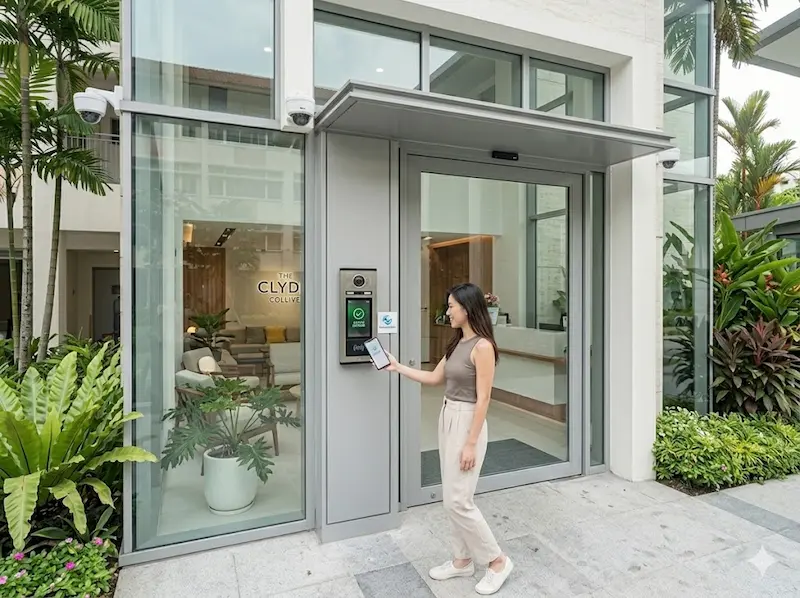
A co-living property is a residential building managed like a hotel but without a hotel's staffing budget. Residents may stay for a few weeks or several months: each arrival requires a new set of access credentials, each departure requires those credentials to be revoked, and the operator typically manages this from a central office without a permanent member of staff at the property. The security system is not augmenting a physical access process: it is the access process.
Mobile-first credential architecture is the foundation of a co-living security system. Residents receive a credential profile on move-in: a smartphone credential via the property's app or a PIN code: that gives them access to the building entrance, their unit, and any shared amenities they are entitled to use. The credential is issued remotely by the property manager without a key handover. When the tenancy ends, the credential is revoked from the management dashboard with a single action: no physical key to recover, no lock to change, no visit to the property required. The access log records every entry event by resident, zone, and timestamp for the full duration of their tenancy. Shared amenity access: gym, laundry, function room, rooftop: is managed through the same credential system, with access permitted only during authorised hours or booked sessions. A resident who books the function room through the property app automatically has their credential updated to permit entry during the booking window; when the booking expires, the access reverts.
Visitor management at a co-living property without a staffed reception needs to be resident-driven rather than operator-driven. An IP video call panel at the building entrance calls the host resident's smartphone directly when a visitor presses the call button. The resident sees the visitor on a live video stream, speaks to them, and releases the building door from their phone: from anywhere. The visit is logged with the timestamp of the call and the gate release. For expected visitors, the resident can generate a pre-registered visitor QR code through the property app: the visitor scans the code at the entrance panel and is admitted during the approved time window without needing to call the resident at all. CCTV covers building entry and exit points, corridors, and shared facility areas: footage is accessible remotely by the property manager from the VESTA dashboard, without dispatching a staff member to the site. The operator's complete view of the property: who is in, who has visited, which facilities are in use, and any access anomalies: is available from any browser.
Credential Lifecycle as Operations: In a co-living property with 40 rooms and weekly turnover, the credential lifecycle: issuing, adjusting, and revoking access for each resident: is one of the most time-consuming operational tasks if done manually. A system integrated with the property management or booking platform handles this automatically: when a booking is confirmed, credentials are issued; when check-out is recorded, credentials expire. The property manager handles exceptions, not routine credential administration.
Hostels & Managed Shared Housing
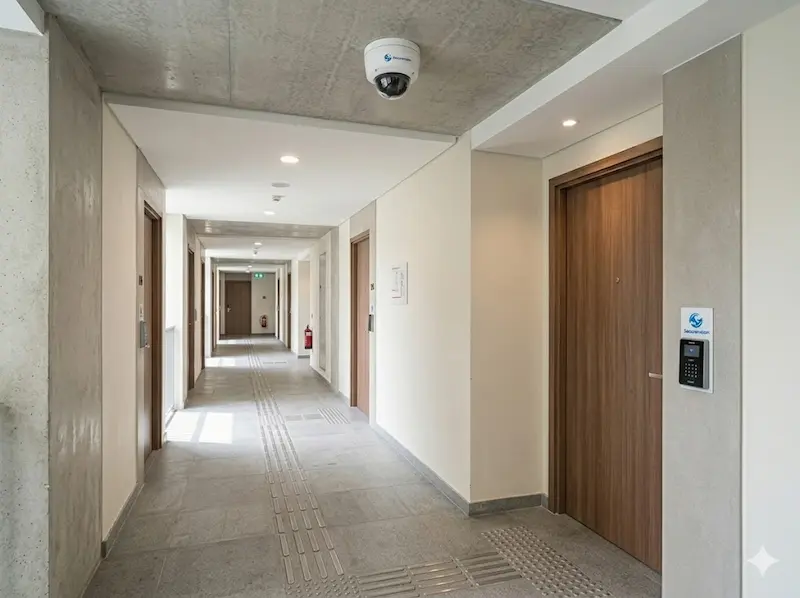
A managed hostel or shared housing facility sits between a co-living apartment and a worker dormitory in scale and complexity: typically serving a mix of short-stay and long-stay residents, with a moderate visitor flow, shared facilities that need to be controlled, and an operator who needs accountability across the property without maintaining a continuous staff presence. The brief is practical: know who is in the building, make sure only residents and authorised visitors can access the shared spaces, and maintain a record of movement that covers both day-to-day operations and the occasional incident that requires investigation.
The building entrance uses an IP video call panel at the main door that calls the host resident's smartphone when a visitor arrives, allowing the resident to see and speak to the visitor and release the door from their phone without staff involvement. Registered residents enter using a card or PIN credential; the entry event is logged with time and identity. Shared facility areas: laundry, common kitchen, TV lounge, study room: use card or PIN readers at the door, so only current residents can access them. A resident who checks out has their credential revoked immediately; they cannot return and access shared areas using a credential that should no longer be valid. For short-stay residents, credentials are issued for the exact duration of the booking and expire automatically at check-out time without any administrative action by the operator.
CCTV covers the main building entrance, shared facility corridors, and the car park or bicycle storage area: providing the operator with a visual record of movement through the property that supplements the access control log. Cameras are positioned at common area access points and the building perimeter, not in private residential areas. When an incident occurs in a shared space: a noise complaint, a missing item, a dispute between residents: the operator can retrieve the relevant camera footage and access log from the VESTA dashboard remotely, without visiting the site or relying on a guard's account of events. For larger hostels with multiple floors or wings, PoE-managed switches at each floor distribution point carry the camera and access network without surface-run cabling that is vulnerable to tampering or accidental damage.
Shared Facilities Without a Guard at the Door: The most common operational complaint at managed hostels is that shared facilities: the laundry, the kitchen, the common room: are used by people who are no longer residents, or accessed at hours when they should be closed. Card access at each shared facility door solves both problems: only current residents can enter, and access is automatically restricted to the permitted hours configured for each room. The access log shows exactly who used which facility and when: useful for both operations management and for resolving the inevitable resident disputes about shared space usage.
Every Person in Your Property Should Be Accountable. Every Access Event on Record.
The three environments covered in this guide operate at very different scales: from a dormitory housing thousands of workers to a co-living building with forty rooms. But the security principle is identical: the operator should know, at any moment, who is in the property, who has been in it, who is visiting, and what each person is permitted to access. In all three environments, that knowledge comes from the same two sources: the access control system and the visitor management record: and both need to be digital, searchable, and current.
The intercom at the entrance is the system that makes visitor management practical without a staffed reception. An IP video call panel that routes to the resident's smartphone means any visitor can be vetted and admitted by their host from anywhere: the operator does not need a guard or a receptionist at the door for this to work reliably. The access log is the system that makes the operator accountable: to residents, to regulators, and to their own property management obligations. A manual logbook and a physical key system cannot produce that accountability at any of the scales managed living properties operate at in Singapore. The digital access record is not a convenience: it is the foundation of the operator's ability to manage the property at all.
Securevision has installed access control, intercom, and CCTV systems across worker dormitories, co-living developments, and managed hostels in Singapore since 2006. Every managed living project starts with the operator's specific requirements: resident population, turnover frequency, operator staffing model, and regulatory obligations: before any system is specified.
Frequently Asked Questions
Questions we hear from dormitory operators, co-living property managers, and hostel owners evaluating a security system upgrade.
What security systems does a managed living property typically need?
Most managed living properties require four integrated components: access control managing who can enter the building, individual units, and shared facilities; visitor management allowing residents or operators to verify and admit visitors without a staffed reception; CCTV covering building entry and exit points, shared facility corridors, and common areas; and a centralised management platform giving the operator a real-time view of access events, visitor logs, and camera feeds from any location. The specific configuration depends on the property type: a worker dormitory, co-living apartment, and managed hostel each have distinct requirements in terms of scale, turnover frequency, and regulatory obligations.
Can the system operate without on-site staff?
Yes: this is the core operational requirement for co-living and smaller managed hostel properties. An IP video call panel at the building entrance calls the host resident's smartphone directly when a visitor arrives. The resident sees the visitor on a live video stream and releases the door from their phone, from anywhere. Credential management is handled remotely by the property manager from the VESTA dashboard. CCTV footage is accessible remotely without dispatching a staff member to the property. The entire property is manageable from a browser or mobile app.
How are resident credentials managed when someone checks out?
When a resident checks out, their credential is revoked from the VESTA dashboard with a single action: no physical key to recover, no lock to change, no visit to the property required. For properties integrated with a booking or property management platform, credential revocation can be automated: when a check-out is recorded in the booking system, the credential expires automatically without any action by the operator. The access log retains the full access history for the tenancy period for operational and compliance purposes.
What MOM compliance reporting can the system produce for worker dormitories?
The VESTA platform generates real-time and near-real-time occupancy records and visitor logs directly from the access control and facial recognition data: in the formats MOM specifies for large dormitory reporting. There is no separate manual log to maintain and no data entry by the guard team beyond the initial enrolment of each resident's biometric profile at check-in. Emergency mustering reports are available from the VESTA dashboard without a manual roll-call across multiple residential blocks.
Can facial recognition process the volume of workers during a shift change at a large dormitory?
Yes: sub-second facial recognition at the entry gantry is the reason facial recognition is specified for high-volume dormitory environments rather than card or PIN access. A registered worker approaches the gantry, their face is matched against the enrolled database in under a second, the barrier opens, and the entry event is logged with the individual's identity, unit, employer, and timestamp. No card to present, no reader to touch, no guard to check against a list. During peak shift-change windows, this throughput is the difference between a smooth entry flow and a queue that backs up onto the public road.
Can existing cameras and cabling be reused in a managed living security upgrade?
Often yes. Existing cameras in adequate condition and compatible with the new NVR may be retained. Existing cabling that passes a continuity check can typically be reused. For co-living and hostel properties with existing intercom wiring, IP video call panels can often replace legacy handset units without full rewiring. We assess existing infrastructure reuse potential during the site survey before agreeing any scope.
How does visitor management work without a staffed reception?
An IP video call panel at the building entrance calls the host resident's smartphone directly when a visitor presses the call button. The resident sees the visitor on a live video stream, speaks to them, and releases the building door from their phone: from anywhere. The visit is logged with the timestamp of the call and the gate release. For expected visitors, the resident can generate a pre-registered QR code through the property app: the visitor scans the code at the entrance panel and is admitted during the approved time window without needing to call the resident at all.
Can multiple properties be managed from one platform?
Yes. The VESTA platform supports multi-property management: an operator with several co-living buildings, hostel properties, or dormitories can manage credentials, access events, visitor logs, and camera feeds across all properties from a single dashboard. Resident credential management for all properties is centralised, so a resident who moves between properties in the same operator's portfolio does not require separate enrolment. Access event reports and occupancy records covering all properties are exportable centrally for portfolio-level compliance management.
The Brands Behind the Systems
Hikvision
IP cameras and facial recognition terminals for managed living properties: AI-analytics models for dormitory perimeter and common areas, standard IP cameras for co-living and hostel corridors and shared spaces.
View Specification →Akuvox
IP video intercom panels at building entrances: calls the resident's smartphone directly, live video stream of the visitor, remote gate release from the resident's phone, and QR code visitor access for pre-registered guests.
View Specification →Access Control
Card, PIN, and mobile credential readers for building entry, unit doors, and shared facility access: remotely managed credential issuance and revocation for high-turnover resident populations.
Explore Access Systems →Hikvision LPR & Facial Recognition
Facial recognition terminals and LPR cameras for high-volume dormitory entry: sub-second resident identification at shift-change throughput, with automatic entry logging and MOM compliance reporting.
View LPR Systems →VESTA Platform
Centralised management platform for all managed living property types: resident credential management, visitor logs, access event history, CCTV access, and compliance reporting from a single dashboard, accessible remotely.
Explore VESTA →Omada & Ruijie
Managed PoE switches and WiFi access points: network infrastructure for CCTV, access readers, and intercom panels throughout the property, with separate VLANs for security and resident WiFi networks.
View Specification →Go Deeper Into Your Property Type
Each managed living environment has a dedicated solutions page covering the operational context, specific system requirements, and what a well-designed installation looks like in practice.
Worker Dormitories
High-volume facial recognition entry, LPR vehicle management, real-time occupancy tracking, visitor and contractor access control, and MOM compliance reporting for Singapore worker dormitories.
Co-living Apartments
Mobile-first credential management, keyless unit and amenity access, smartphone intercom for visitor management, remote operator visibility, and automated credential lifecycle for Singapore co-living properties.
Hostels & Managed Housing
Card and PIN resident access, IP video intercom for visitor control, shared facility access management, CCTV for common areas, and remote incident review for Singapore managed hostels and shared housing.
Ready to Take Control of Who Is In Your Property?
Tell us about your property and your resident population. We will design a system that gives you the access control, visitor management, and movement accountability your operation requires.
Licensed by the Police Force: Licence · Serving Singapore since 2006