Improve CCTV Visibility: See What Your Current System Is Missing
Many CCTV systems are installed, but not optimised. Blind spots, poor night visibility, and difficult footage retrieval limit their effectiveness when it matters most.
Helping MCSTs and site managers reveal hidden risks across Singapore since 2006.
In Short
What CCTV Visibility Actually Means
Many CCTV systems record footage but still fail when an incident occurs: because important details cannot be seen clearly, critical areas are not covered, or the relevant footage cannot be found quickly. Improving CCTV visibility is not simply about adding more cameras. It involves eliminating blind spots, improving performance in low-light conditions, reducing footage search time, and ensuring cameras are positioned and specified to capture what an investigation actually needs.
The question is not "can we see the area?" The question is "can we identify the person, vehicle, or event when something happens?" Those two questions often produce very different answers: and very different camera specifications.
Most CCTV Systems Record: But Do Not Provide Real Visibility
In many properties, CCTV systems are already in place. But when incidents happen, critical areas are often not clearly captured, lighting conditions reduce visibility, or important details are missed. The issue is not the absence of cameras. It is whether the system allows you to actually see, understand, and respond.
Unclear Details
Incidents captured on video are too grainy or distant to serve as useful evidence: faces are unrecognisable, licence plates are unreadable, and the footage that exists cannot support an investigation or insurance claim.
Night Failure
Cameras that work acceptably in daylight become unusable in low-light or night conditions. Most customers discover this limitation only after an incident occurs after dark: at which point the footage that should have answered the question is either black or too noisy to read.
Slow Search
Finding a specific event in continuous footage recorded across multiple cameras requires hours of manual review. This delays investigations, frustrates management, and means that time-sensitive footage is often not reviewed before its evidentiary value is lost.
Blind Spots
Poor camera placement: or a site layout that has changed since the original installation: leaves critical access routes, corners, and transition zones completely uncovered. An incident in a blind spot leaves nothing to investigate regardless of how many cameras exist elsewhere on the site.
Common Gaps That Limit CCTV Effectiveness
These are the issues we find most consistently when reviewing CCTV systems across Singapore properties before a visibility upgrade.
Blind Spots from Poor Placement
Areas not covered due to poor camera placement, outdated site layouts, or original designs that prioritised cost over coverage continuity. A gap between two camera fields of view is all an incident needs to go unrecorded.
Low Light Performance
Footage becomes unclear, monochrome, or completely black in dim conditions or night environments. Cameras specified without considering Singapore's outdoor lighting: car parks, driveways, perimeter paths: consistently underperform after dark.
Narrow Coverage
Too many cameras covering limited individual fields of view, creating gaps at the transitions between adjacent cameras. Incidents happen most frequently at access points: exactly the areas where coverage continuity matters most and gaps are most common.
Footage Retrieval Takes Too Long
Wasting hours of staff time searching for events because the recorder stores continuous footage with no event indexing. The inability to find footage quickly is often the difference between a useful investigation and an inconclusive one.
When Visibility Is Limited, Response Becomes Reactive
When footage is unclear or hard to access, your security posture weakens significantly. CCTV should reduce uncertainty, not create more of it. Most sites do not suffer from too few cameras. They suffer from cameras that are positioned, specified, or configured in ways that produce footage that cannot answer the questions an investigation requires.
Incidents become harder to verify or prove. Operational response is delayed by lack of real-time information. Guards are forced to rely on manual patrol rather than technology-enabled monitoring. Investigations become time-consuming and often inconclusive: not because nothing was recorded, but because what was recorded is not useful.
The Uncertainty Gap
If your current system cannot identify a person or a licence plate at night, it is providing a false sense of security rather than genuine protection. The cameras are present. The recording is running. But the footage produced cannot support the outcomes the system was installed to deliver.
Common Mistakes We See in CCTV Projects
After reviewing CCTV systems across condominiums, offices, factories, and commercial properties, several issues appear repeatedly.
Adding More Cameras Instead of Solving Blind Spots
More cameras do not automatically create better visibility. Often the issue is camera positioning rather than camera quantity. A site with thirty cameras positioned poorly produces less useful footage than a site with twelve cameras positioned correctly. We see this most commonly in properties where cameras have been added incrementally over years without a coverage review: the total count is high but the gaps remain.
Comparing Megapixels Alone
Many buyers focus on resolution specifications but overlook lens selection, lighting conditions, and camera placement: all of which have a greater effect on the quality of evidentiary footage than megapixel count. A higher-resolution camera in the wrong position, with the wrong lens, pointed into a light source, produces worse results than a lower-resolution camera specified correctly for its environment.
Ignoring Night Performance
Most CCTV systems look acceptable during daylight. The real test comes after sunset. Cameras specified for daytime performance: with insufficient sensor sensitivity, limited IR range, or no low-light capability: routinely fail to capture identifiable footage in the lighting conditions that most outdoor Singapore environments produce at night. The limitation is only discovered after an incident occurs in darkness.
Designing for Coverage Rather Than Investigation
Camera placement decisions are often made to maximise the visible area on a site plan rather than to capture the information an investigation would need. A camera angled to show that an area is "covered" may produce footage that cannot identify anyone in that area. The design question should always be: if something happens here, what do we need to see, and from what angle do we need to see it?
A Practitioner Observation
The most common finding from our CCTV assessments is not that sites have too few cameras: it is that the cameras they have are not positioned, specified, or configured to produce useful footage when something goes wrong. The assessment almost always reveals two or three specific changes that would produce a significant improvement without requiring a full system replacement.
Designing CCTV Systems for Clarity, Not Just Coverage
Improving CCTV performance is not just about adding more cameras. It involves identifying gaps, improving night visibility, and optimising camera placement for real outcomes.
Gap Analysis
Walk every access point and zone to identify uncovered areas and camera blind spots on the current layout. We map what is covered and what is not: and where the transitions between adjacent cameras create opportunities for events to go unrecorded.
Light Audit
Test each camera's night and low-light performance to identify where IR range or sensor sensitivity is insufficient for the environment it is covering. This is done in actual site conditions, not against specification sheets.
FOV Mapping
Map field-of-view angles for each camera position to eliminate gaps between adjacent camera transitions and confirm that the footage produced from each position captures the identification details an investigation would require.
Retrieval Test
Test how long it takes to locate a specific event on the recorder: and determine whether smart event indexing is in place. A recorder that requires manual fast-forward through hours of footage is a bottleneck that makes every investigation slower and less reliable.
What a Visibility-First System Should Deliver
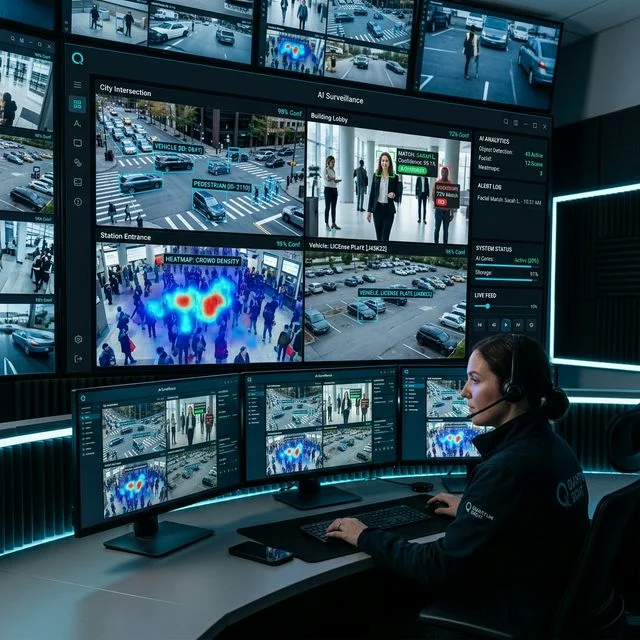
Eliminate Blind Spots
Coverage gaps are identified through site-based placement planning and digital field-of-view mapping before any hardware is specified. The objective is continuous coverage across all access routes: so that there is no position on site where an event can occur without being captured by at least one camera with an adequate angle for identification.
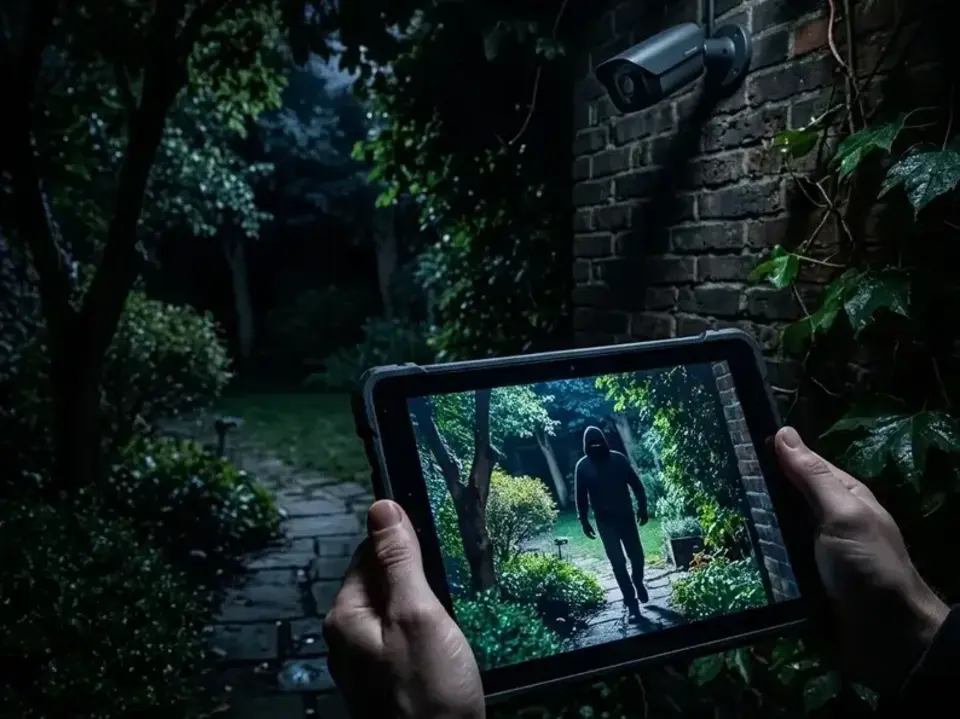
See Clearly Even in Low Light
Modern cameras with large image sensors and wide aperture lenses maintain full-colour footage in conditions where older cameras produce black-and-white or unusable images. For outdoor environments with minimal artificial lighting: perimeter paths, open car parks, driveways: specifying the right sensor and aperture combination is more important than any other camera specification. We test night performance on site before finalising any camera specification.
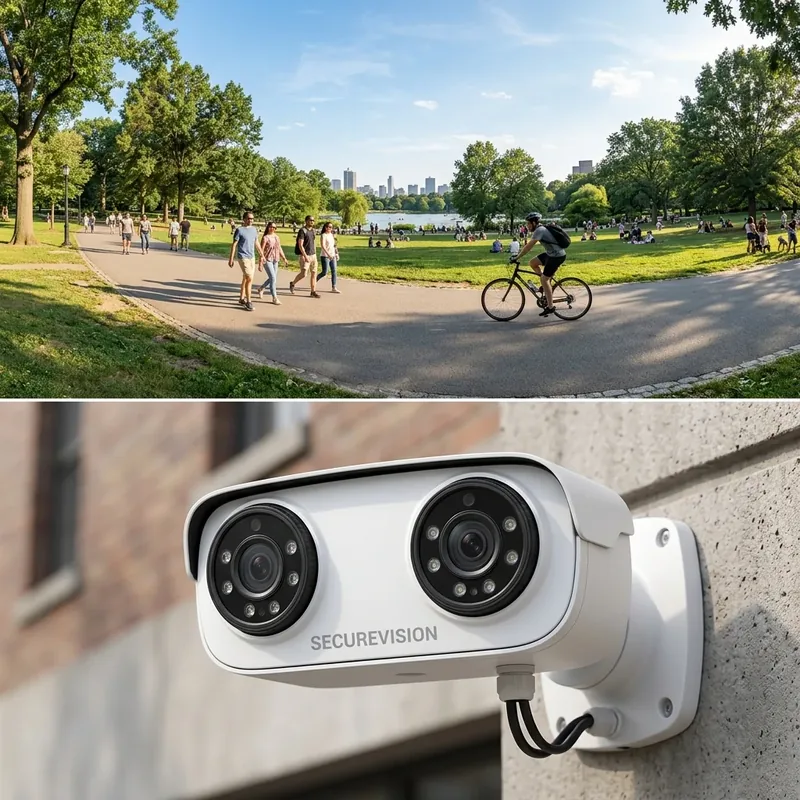
Wider Coverage, Fewer Cameras
Wide-angle panoramic cameras covering entire lobbies or open spaces from a single mounting point reduce the number of transition gaps between adjacent camera fields of view. Most sites do not suffer from too few cameras: they suffer from cameras that are looking at the wrong places or producing overlapping coverage of low-risk areas while leaving high-risk transitions uncovered. A panoramic camera in the right position resolves this more effectively than adding two additional standard cameras.
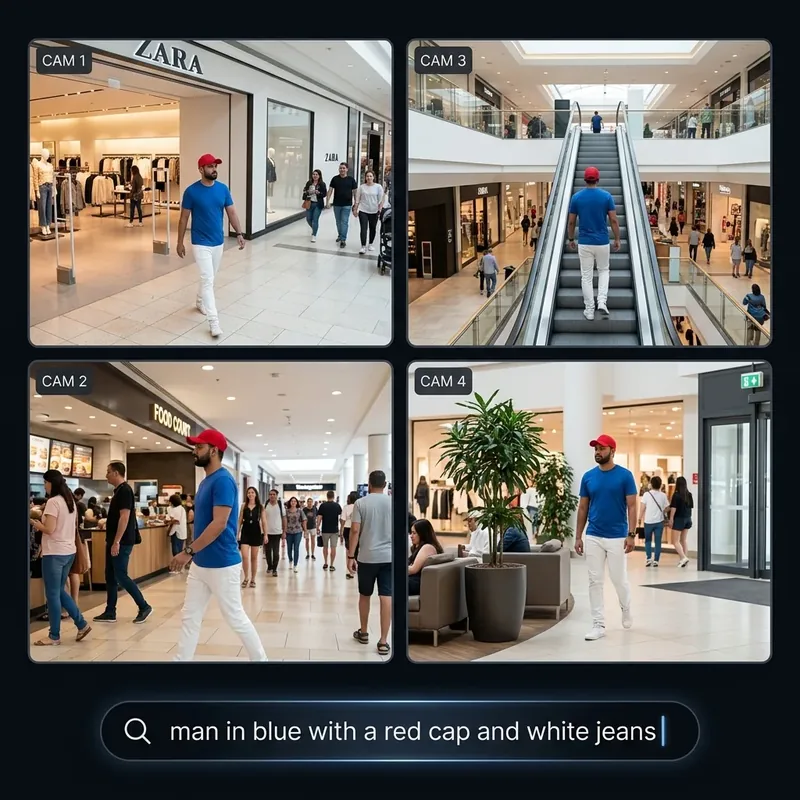
Faster Video Search
Smart recorders with event indexing allow footage to be filtered by human movement, vehicle activity, or specific zones: so a relevant clip that would take hours to find through manual review can be located in minutes. We configure the indexing parameters during commissioning based on the site's specific investigation requirements, and train the operations team on how to use the search tools effectively.
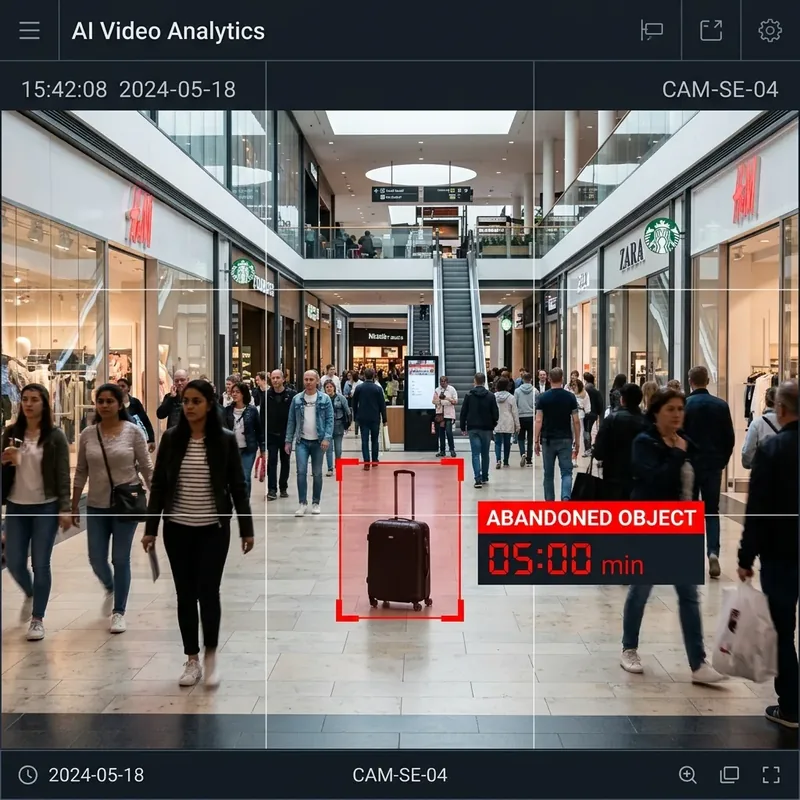
AI Video Analytics
Analytics-enabled cameras detect and alert on specific events: intrusion across a defined line, loitering in a high-risk zone, an unattended object left in a corridor: rather than requiring a guard to watch live footage continuously. This shifts CCTV from a passive recording system to an active alert system. The guard's attention is directed to events that require a response, rather than divided across screens showing routine activity.
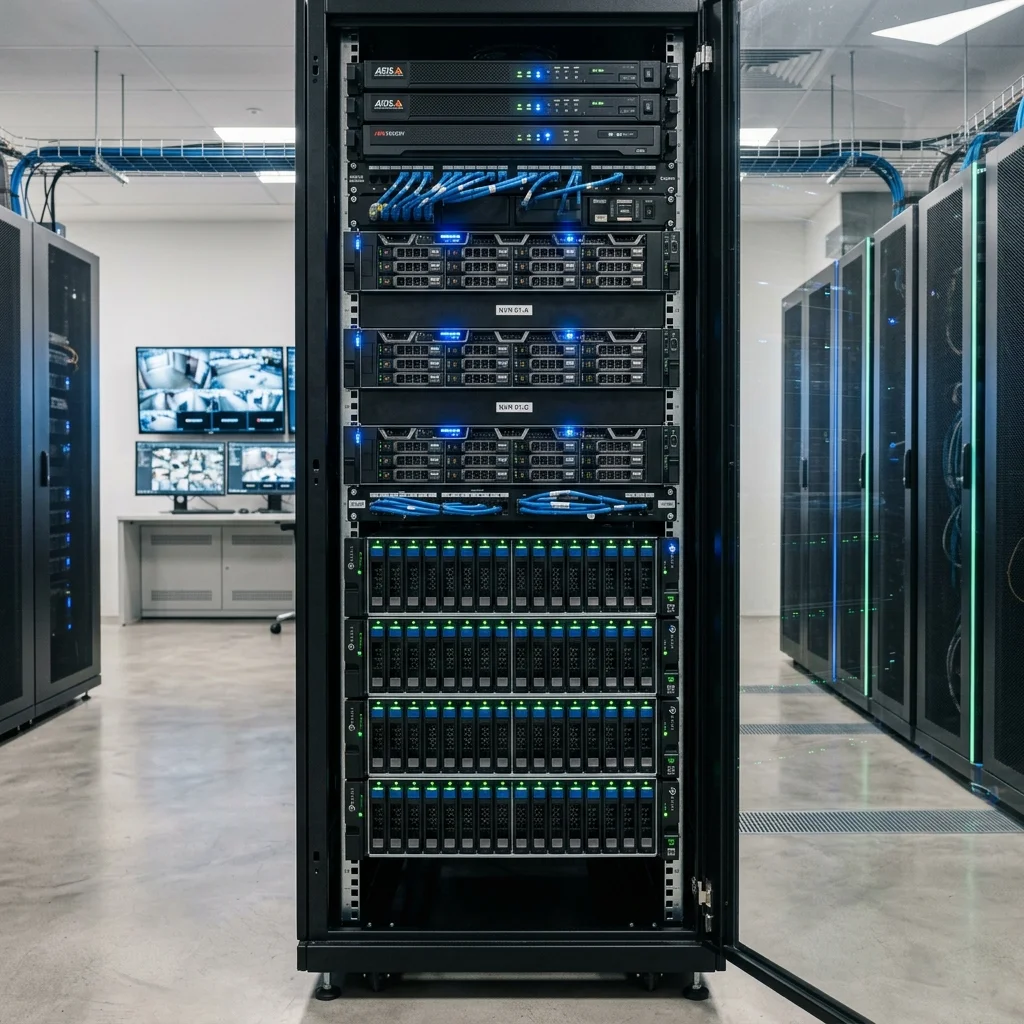
Reliable Footage When You Need It
Cameras that capture good footage but overwrite it before an incident is reported serve no investigative purpose. Storage capacity and retention period are part of the visibility brief: a system designed around the property's camera count, resolution, and required retention window ensures that footage is retrievable on demand.
- Retention configured to site requirements
- Storage scaled to camera count and resolution
- Footage accessible remotely for management review
What Improves After a CCTV Visibility Upgrade
A visibility-first upgrade produces improvements across the operational outcomes that a CCTV system is installed to deliver: not just better footage quality on a specification sheet.
Incidents are captured with sufficient clarity to support investigation and insurance claims. Night coverage produces identifiable footage rather than black or noisy images. Footage retrieval that previously required hours of manual review takes minutes with event-indexed search. Analytics-enabled cameras reduce the false alarm burden on security teams by filtering out routine activity and alerting only on genuine events.
Operational Improvements
What Affects the Cost of a CCTV Visibility Upgrade?
A site with ten cameras may require a larger investment than a site with thirty cameras if the operational requirements and existing infrastructure are significantly different.
Scope of Camera Replacement
A targeted upgrade replacing only the cameras causing the most significant visibility problems costs considerably less than a full system replacement. The assessment determines which cameras can remain and which need to be replaced: so the scope is based on what is actually limiting visibility, not on a default assumption that everything needs to go.
Existing Cabling Infrastructure
Sites where existing coaxial or Cat5 cabling can be reused with appropriate signal conversion hardware cost less to upgrade than sites where full recabling is required. Cable condition, run lengths, and routing all affect whether reuse is practical. We assess this during the site visit before any scope is agreed.
Night and Low-Light Requirements
Cameras specified for full-colour low-light performance in challenging outdoor conditions: open car parks, perimeter paths, unlit areas: carry a higher unit cost than standard cameras. The number of positions requiring this specification is driven by the site's lighting conditions and the coverage priority of each location.
Analytics and Smart Search Requirements
Adding AI analytics capability: event detection, intrusion alerts, smart footage search: requires cameras and recorders with the necessary processing capability. Whether this is introduced across the full system or at specific high-priority locations affects the total scope significantly.
Recorder and Storage Upgrade
Upgrading to a recorder with smart event indexing may require replacing the existing NVR or DVR. Storage requirements increase with camera resolution and retention period. We calculate the exact storage specification for your camera count and retention requirement as part of the design phase.
Site Complexity and Access
Multi-building sites, elevated or difficult-access mounting positions, and occupied premises requiring installation outside operational hours all affect the installation cost. A compact single-building site and a large multi-block estate with complex mounting requirements represent fundamentally different scopes even at similar camera counts.
A Practitioner Observation
The most cost-effective CCTV upgrades we have worked on started with a clear understanding of what the current system cannot do: rather than a decision to replace everything with the latest equipment. In most cases, two or three targeted changes produce the improvement the site actually needs. The assessment is what makes that determination possible.
Experience in Real-World Visibility Challenges
Enterprise-Level Deployments
From complex urban developments like *SCAPE to high-density residential estates, we have worked through the most difficult visibility challenges across Singapore: and the findings consistently point to placement, specification, and configuration rather than camera count as the primary variables.
Assessment Before Specification
We consult with your security teams and managing agents first to understand what you need to see, then we design the technology to deliver it. No camera is specified before the site assessment establishes what it needs to capture and in what conditions.
Analytics Integration
We specialise in integrating high-performing cameras with intelligent analytics and video management platforms: so the system produces both the clear footage and the event-indexed retrieval capability that makes CCTV useful when something actually happens.
Frequently Asked Questions
Questions we hear from property managers and site owners assessing their current CCTV system.
Can I upgrade to IP cameras without replacing all the cabling?
In many cases yes. Existing coaxial cabling can be reused with a balun converter that carries IP signal over analogue cable. Whether this is appropriate depends on the cable condition and length. For runs over 80m or cables in poor condition, we recommend direct Cat6 replacement. We assess existing cabling during the site visit and give you a specific recommendation before proposing any hardware.
Why are my cameras clear during the day but blurry at night?
This is almost always an IR illumination or lens aperture issue. Cameras with insufficient IR range or a fixed aperture lens struggle in low-light conditions. Cameras with large sensor sizes and adjustable aperture lenses perform significantly better at night. In some cases the issue is also a dirty lens or condensation on an outdoor housing: we check these physical factors during the assessment before recommending hardware changes.
What does AI CCTV actually do that standard CCTV does not?
Standard CCTV records everything and does nothing with the footage until someone reviews it. AI cameras analyse the footage in real time and alert your security team when specific events occur: a person entering a restricted zone, a vehicle parking in a no-stopping area, an unattended object left in a corridor, loitering at an exit. This changes CCTV from a passive record to an active alert system. You see fewer hours of footage review and more relevant, timely responses.
How much storage do I need and how long is footage retained?
Storage requirements depend on the number of cameras, resolution, and compression settings. We calculate the exact storage needed for your specific camera count and retention requirement during the design phase. For most residential and commercial sites, 30 days retention at 2MP resolution is standard. For sites with compliance or insurance requirements for longer retention, we size storage accordingly and document the configuration.
Do I need to replace my entire CCTV system to improve visibility?
Not necessarily. Many improvements can be achieved by upgrading selected cameras, improving placement, adding a smart recorder with event indexing, or introducing analytics: without replacing the entire system. The first step is understanding what specific visibility problem you are trying to solve. We begin every engagement with an assessment that identifies which components are limiting your visibility before recommending any replacement scope.
How long does a CCTV visibility upgrade take?
For a straightforward camera replacement or recorder upgrade at a single site, installation typically takes one to two days. Larger properties with significant cabling work, multiple buildings, or new infrastructure requirements take longer. We present a clear installation schedule as part of the proposal so there are no surprises on site.
Can panoramic cameras replace multiple standard cameras?
In some locations yes: wide open areas such as car parks, lobbies, and open courtyards are well suited to panoramic cameras that provide 180-degree or 360-degree coverage from a single mounting point. However panoramic cameras are not suitable for all locations. Long corridors, perimeter lines, and areas requiring facial or plate identification at distance still benefit from dedicated directional cameras. We specify camera type based on what each location needs to capture.
What is the difference between smart search and standard footage review?
Standard footage review requires a person to watch recordings in real time or fast-forward through hours of video to find a specific event. Smart search on a modern video management recorder allows you to filter footage by event type: human movement, vehicle activity, or specific zones: and jump directly to relevant clips. An incident that might take two hours to locate through manual review can be found in a few minutes with smart search. We configure the search parameters during commissioning and train your team on how to use them effectively.
Related Solutions
CCTV visibility improvements work best alongside these complementary upgrades.
Reduce Guard Manpower
AI cameras that alert guards only when action is required: eliminating the need for constant monitor watching and redirecting guard attention to genuine events.
Automate Vehicle Access
LPR cameras at entry points serve dual purpose: they automate gantry access and provide clear vehicle footage simultaneously, combining two functions in one camera position.
Improve Visitor Management
Camera coverage of visitor check-in and waiting areas provides the audit trail that complements digital visitor logs: connecting the visual record to the registration record.
Ready to See What Your Current System Is Missing?
Tell us about your site. We will assess your camera coverage, night performance, and footage retrieval: and show you exactly where the gaps are.
Licensed by the Police Force: Licence · Serving Singapore since 2006