Care Facility Security Must Be Invisible to Residents and Immediate for Staff.
Nursing homes and day care centres need security that prevents wandering, manages visitors, and supports MOH compliance: without harshness.
Supporting Singapore care facilities since .
In Short
Security That Supports Carers: Not Manages Residents
A care facility is not primarily a security environment. It is a care environment. Security exists to support caregivers, not to replace them. Every design decision: which alert goes to which device, how a door controller sounds in a sensory-sensitive space, how visitor records are formatted for MOH inspection: is made around the carer's workflow, not around the technology's default settings.
The system's value is measured by whether it makes the duty carer's job faster, more accurate, and less physically exhausting. A safe-zone breach alert that reaches the facility manager's desktop is a documentation system. An alert that reaches the duty carer's phone with the door location and camera reference, within three seconds of the event, is a safety system. The difference is in how the system is configured and tested against the actual carer workflow: not in the hardware specification.
Security That Protects Without Confining. Monitors Without Surveilling.
A care facility security system operates under a constraint that no other environment imposes: the people it is protecting may not be capable of understanding why certain areas are restricted, why a door does not open when they approach it, or what the cameras on the wall are for. A resident with dementia who tries to leave a safe zone is not a security threat: they are a person in distress whose safety depends on the system alerting the right carer instantly and without drama. The technology must manage this without physical barriers, without visible alarms, and without creating an atmosphere that distresses the people it is meant to protect.
The other dimension that distinguishes care facility security is regulatory. The Ministry of Health's licensing requirements for nursing homes and day care centres have specific implications for how security and monitoring systems are documented and operated. Camera placement records, visitor access logs, and alert history are not just operational data: they are evidence that the facility is meeting its duty of care, available for inspection at any time. This guide covers two care environments in Singapore: nursing homes and residential aged care facilities, and day care and specialist care centres.
Common Mistakes We See in Care Facility Security Projects
After reviewing nursing homes and care centres across Singapore, several design and configuration mistakes appear repeatedly: almost all of them in how the system is specified rather than in what hardware is chosen.
Designing the System Around Restriction Rather Than Care
Systems designed primarily to prevent residents from leaving: locked doors, audible alarms, visible barriers: create distress and resistance in residents who do not understand why the environment has changed. The better design brief is a system that alerts the carer immediately when a resident approaches an exit, giving the carer time to reach them gently before they reach the door. The difference between a restriction system and a care support system is not in the hardware: it is in how the response workflow is designed.
Routing Alerts to a Security Desk Instead of a Carer
A safe-zone breach alert that arrives at a guardhouse security terminal or a facility manager's desktop is not useful for preventing an incident: it is useful for documenting one. The alert needs to reach the duty carer responsible for the relevant zone, on their mobile device, within seconds of the event. Every step between the alert and the carer adds time that the resident is unsupervised. Alert routing design is where most care facility security systems either succeed or fail.
Applying One Alert Configuration to Every Resident
Different residents have different risk profiles. A resident with high wandering behaviour during the night requires a more sensitive alert threshold than a mobile resident who walks purposefully to the dining room every morning. Alert configurations should be mapped to individual resident risk profiles during commissioning: and updated when a resident's condition changes. A default system-wide alert setting that generates the same alert for every door approach will produce alert fatigue within weeks.
Specifying Cameras Without Considering Dignity and Consent
The objective of CCTV in a care facility is safety: not comprehensive surveillance of every space where a resident may be. Camera placement must balance the monitoring requirement against the resident's right to privacy and dignity. Bathrooms, private bedrooms, and personal care areas require careful consideration and, where applicable, documented consent. A camera placement plan that covers every square metre of the facility is not a better safety system: it is a liability.
A Practitioner Observation
We approach healthcare security differently from many security contractors. A care facility is not primarily a security environment: it is a care environment. The most common mistake we see is a security system that was designed by people who understand security but not care: technically correct, operationally disruptive, and resisted by the carer team within months of handover. Every care facility project we commission ends with a full walkthrough of every alert type with the carer team present, every device tested, and every escalation path confirmed before the system goes live.
Nursing Homes & Residential Aged Care
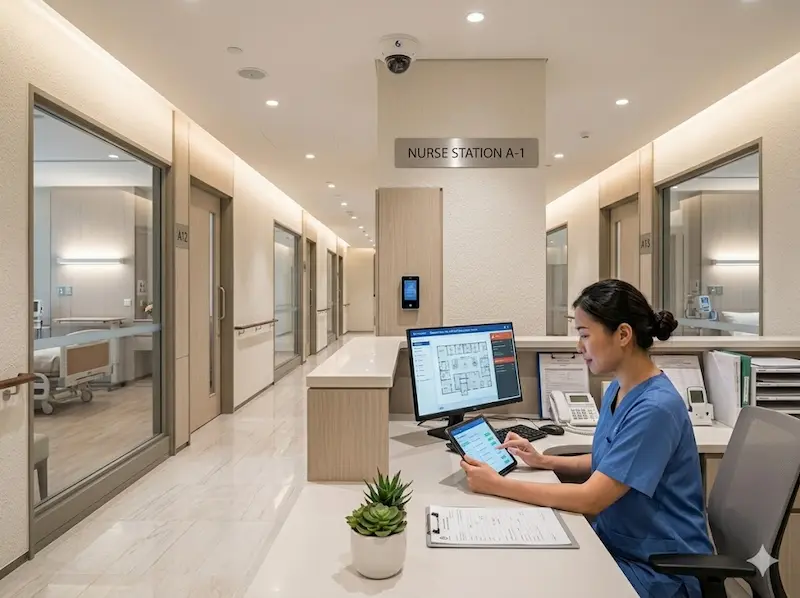
A nursing home is a residential facility first and a secure facility second. The security architecture must reflect that order of priority. Residents who have dementia or limited mobility are not confined: they live in their home, move through it freely within safe zones, and receive visitors who are part of their daily life. The systems that protect them must operate within that residential character, not against it.
Safe-zone monitoring is the central function. Door controllers at the exit points of each residential unit, at stairwell entries, and at the facility's perimeter exits require a staff card or PIN to operate: a resident cannot open them independently, but neither do they look or sound like a security lock. When a resident approaches one of these doors, the access controller generates an immediate alert on the duty nurse's mobile device with the door location, before the resident reaches the exit. AI camera analytics on corridor cameras supplement the door-based monitoring: movement detection configured for the night-time quiet hours generates an alert when a resident leaves their room during a period when no movement is expected, allowing the nurse on duty to check without conducting a physical patrol of every corridor. Fall detection on cameras in high-risk areas: bathrooms, bedrooms, dining rooms: uses posture analysis to detect a person who has fallen and generates an alert with a camera reference and timestamp. These three layers: door controllers, AI corridor monitoring, and fall detection: operate simultaneously and independently, so a gap in any one layer is covered by the others.
Visitor management at a nursing home has a duty-of-care dimension that goes beyond a visitor log. Family members, therapists, volunteers, and contractors all have access to a vulnerable resident population: the facility needs to know who is on-site, which resident they are visiting, and when they arrived and departed. A digital visitor terminal at reception registers every visit with the visitor's identity, their purpose, the resident they are seeing, and their access window. Regular visitors: family members on a fixed schedule, recurring therapists: can be pre-registered for automatic entry within visiting hours. Contractors are issued time-limited credentials restricted to the zones their work requires and no others. The visitor log is available for MOH licensing inspections and family inquiries without any manual compilation. The VESTA platform routes alerts, logs every access event, and generates incident documentation in a format suitable for the facility's safety management records: the same record that answers a family's inquiry about an incident also satisfies an MOH inspector's request for documentation.
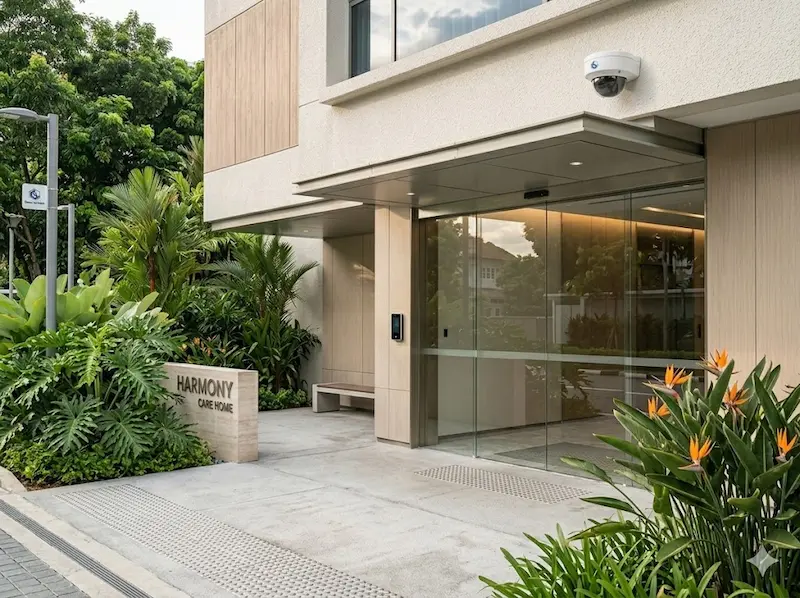
Hardware That Belongs in a Home: Cameras in a nursing home are specified with no visible indicator lights and housings that match the décor of the space they are in. Door controllers look like standard hardware, not access control terminals. Intercom stations can be configured to operate without audible tones in areas where noise causes distress. The security system should not be perceptible to residents as a surveillance infrastructure: it should be part of the building they live in.
Day Care & Specialist Care Centres
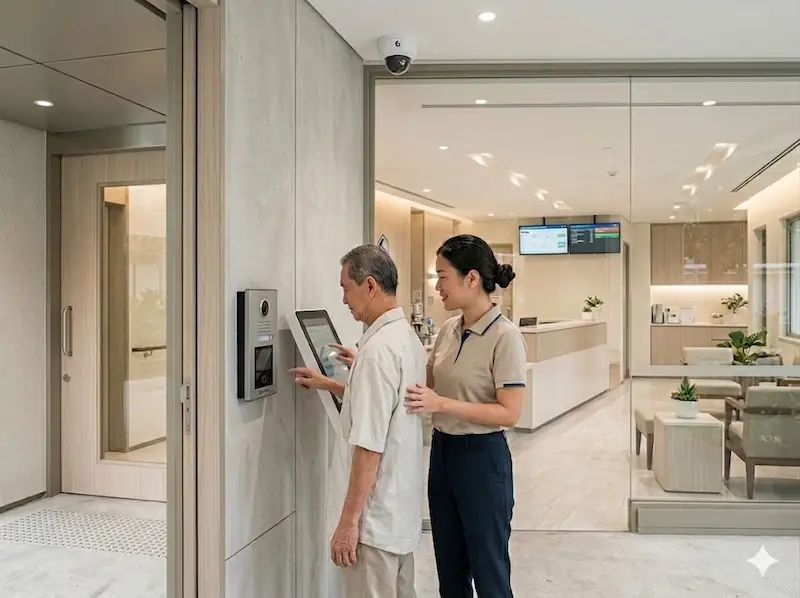
A senior day care centre or specialist centre for adults with autism or cerebral palsy presents a distinct brief from a nursing home. Participants arrive each morning and leave each afternoon: the facility must manage an active arrival and departure flow with families and transport operators, a full-day programme across multiple zones of the facility, and a visitor population that includes therapists, healthcare professionals, and MOH inspectors. The resident population is not confined overnight, but during the session hours the duty of care is total: every participant's location must be accountable, and every alert must reach the right carer in time to prevent the incident rather than document it after the fact.
The safe-zone architecture for a day care centre is zone-based rather than room-based. Activity areas, the dining space, and the therapy rooms are free-movement zones: participants move through them freely as part of the programme. Exit points to the street, the car park, and any area outside the supervised programme boundary are access-controlled: door controllers that require a staff card or PIN to open, generating an alert on the duty carer's mobile device the moment a participant approaches. For participants with autism who are highly sensitive to audible hardware, door controllers are configured to operate silently: no beep, no tone, no sound that could trigger a stress response. AI camera analytics on cameras covering the programme area detect when a participant moves into an unmonitored space, remains unattended beyond a defined time threshold, or falls, routing the alert to the named carer responsible for that participant's zone based on the shift assignment in VESTA. The alert includes the camera reference and zone location so the carer knows exactly where to go, without leaving their current participant unattended to conduct a general search.
Visitor management at a day care centre is operationally complex because the visitor population is diverse and arrives frequently throughout the session day. Family members dropping off and collecting participants, regular therapists with their own schedules, ad-hoc health professionals, and MOH inspectors all arrive at the reception entrance and need to be managed without creating a queue at the door that disrupts the programme. Pre-registered visitors: regular therapists, family members: enter within their pre-approved time window without requiring manual reception authorisation on each visit. Their arrival triggers a push notification to the reception coordinator so the visit is acknowledged, but no staff member needs to leave their current task to manage it. Ad-hoc visitors are verified at the reception terminal and admitted manually. Every visit is logged with the visitor's identity, purpose, arrival time, departure time, and the participant they are there to see: the complete record available for MOH licensing inspection at any time, without compilation.
Alert Routing That Matches Carer Ratios: A generic broadcast alert to every carer device when a participant approaches an exit creates alert fatigue: staff begin ignoring alerts because they receive too many that are not relevant to their zone. VESTA routes each alert to the specific carer assigned to the relevant zone during the current shift, with escalation to the next available carer if the alert is not acknowledged within a defined window. This is configured during commissioning around the facility's actual shift structure and carer-to-participant ratios: it is not a default setting. We do not hand over a system that has not been tested against the facility's live carer workflow before the first day of operation.
The System Exists for the Carer, Not the Manager.
In every other sector covered by these guides: commercial, industrial, institutional: the primary user of the security system is a manager, a guard, or a facilities team. In a care facility, the primary user is the carer on the floor: the nurse doing the overnight rounds, the day care aide managing six participants across three activity zones, the therapist who needs to know immediately if a participant has left the supervised area. The system's value is measured entirely by whether it makes that person's job faster, more accurate, and less physically exhausting: not by the number of cameras installed or the sophistication of the management dashboard.
This means the design decisions that matter most are not about hardware specifications. They are about alert routing: which alert reaches which device, in what sequence, with what information. A safe-zone breach alert that reaches the facility manager's desktop is not a security system: it is a documentation system. An alert that reaches the duty carer's phone with the door location and a camera reference, within three seconds of the breach event, is a safety system. The difference between those two outcomes is how the system is configured during commissioning, tested against the actual carer workflow, and maintained over its service life.
Securevision has installed and commissioned security systems in nursing homes and care centres across Singapore. Every care facility project ends the same way: with a full walkthrough of every alert type with the carer team present, every device tested, and every escalation path confirmed before the system goes live. The handover documentation is formatted for the facility's MOH licensing records, not for the integrator's project file.
What Affects the Cost of a Care Facility Security System?
Most care facility security projects are not driven primarily by camera count. They are driven by workflow complexity: how many distinct alert types, how many carer zones, and how tightly the system needs to integrate with the facility's shift structure.
Number of Residents, Zones, and Exit Points
Each controlled exit point requires its own door controller and alert configuration. Each resident or participant zone requires its own alert routing rule. A compact single-floor nursing home with eight controlled doors and two resident zones is a fundamentally different scope from a multi-floor facility with twenty-four controlled exits and six distinct zones: even at a similar total resident count.
Alert Routing Complexity and Carer Workflow Integration
Configuring the alert routing platform around the facility's actual shift structure, carer-to-resident ratios, and escalation workflow is the most time-intensive part of a care facility security project. The configuration must be tested against the live carer workflow: not against a default template: before the system goes live. Facilities with complex shift structures and high carer-to-resident ratios require more configuration time than those with straightforward rosters.
Fall Detection and AI Analytics Scope
Fall detection cameras require specific placement angles and clear line-of-sight to the coverage area to perform reliably. High-risk areas: bathrooms, bedrooms, dining rooms: each require their own camera positioned for posture analysis coverage. The number of high-risk areas and the facility's layout determine the camera count for fall detection. This is typically the largest driver of camera count in a care facility project, not general corridor surveillance.
Existing Infrastructure and Network Readiness
Care facilities with structured cabling, managed network switches in serviceable condition, and compatible existing camera infrastructure can be upgraded at lower cost than those requiring full infrastructure installation. Network readiness is particularly important for carer alert delivery: alert routing latency is affected by network configuration, and a poorly configured network can add seconds to alert delivery that matter in a wandering or fall incident.
A Practitioner Observation
The most consistent cost variable in care facility security projects is the alert routing configuration: not the hardware. A facility with a straightforward two-zone shift structure and a clear escalation policy can be commissioned significantly faster than one where the carer team is still deciding how alerts should be distributed at the time of commissioning. The workflow decisions should be made before the system is specified, not during installation.
The Brands Behind the Systems
Hikvision
AI-capable IP cameras for safe-zone monitoring, fall detection, and corridor movement analytics in care facilities: specified with no visible indicator lights and housings suited to residential and clinical environments.
View Specification →Access Control
Door controllers at safe-zone exit points: silent operation for sensory-sensitive environments, staff card and PIN access, and immediate alert generation on the duty carer's device when approached.
Explore Access Systems →VESTA Platform
Alert routing platform for care facilities: routes each alert to the named carer responsible for the relevant zone, with configurable escalation if not acknowledged, and generates incident logs formatted for MOH documentation.
Explore VESTA →Akuvox
IP video intercom at the facility entrance: video verification of visitors before admittance, family mobile app access for pre-registered visitors, and QR code entry for approved visiting windows.
View Specification →Visitor Management
Digital visitor terminal at reception for logging family members, therapists, and contractors: pre-registration for regular visitors, manual approval for ad-hoc visits, and a complete audit trail for MOH licensing inspections.
Explore Visitor Systems →Omada & Ruijie
Managed PoE switches and WiFi access points: reliable network infrastructure for CCTV, access control, and VESTA across the facility, with separate VLANs for security and clinical IT systems.
View Specification →Frequently Asked Questions
Questions we hear from nursing home operators, day care centre managers, and care facility owners evaluating security systems.
What security systems does a nursing home or care facility typically need?
Most Singapore nursing homes and care facilities require three integrated layers: safe-zone monitoring with door controllers at exit points that alert the duty carer when a resident approaches; AI camera analytics for fall detection and night-time corridor movement monitoring; and visitor management with a digital log for MOH licensing compliance. These are supported by a carer alert routing platform that sends each alert to the right carer device. The specific configuration depends on the resident profile, facility layout, and carer-to-resident ratio.
Can CCTV cameras detect falls reliably in a care facility?
AI-capable cameras with posture analysis can detect a person who has fallen and generate an alert with a camera reference and timestamp. Reliability depends on camera placement and coverage angle: the camera must have a clear view of the area where a fall is likely to occur. Fall detection is one layer of a broader carer alert system, not a standalone solution. It supplements door monitoring and corridor movement analytics rather than replacing physical carer rounds.
Are cameras allowed in resident rooms in Singapore nursing homes?
Camera placement in resident rooms is subject to MOH guidelines on resident privacy and dignity. Cameras in bathrooms are not permitted. For bedrooms, placement and purpose must be documented and consented to where applicable. We design camera placement to balance safety monitoring with resident privacy: typically covering common corridors, dining areas, and facility exits rather than private spaces, with fall detection cameras positioned to cover high-risk areas while respecting dignity.
Can family members view cameras at the care facility?
Remote camera access for family members raises significant privacy issues in a multi-resident environment: a family member viewing the dining room camera will also see other residents. This is generally not configured as a standard feature. Where family monitoring needs are a concern, we discuss the appropriate approach with the facility operator, which may include designated on-site viewing sessions or limited access to cameras covering only the relevant resident's private space, subject to consent.
What happens if the WiFi or network fails at a care facility?
Access control hardware is configured with local storage and offline mode: safe-zone door controllers continue to function during network interruptions. Camera recording continues to the on-site NVR regardless of network status. For alert routing, we specify wired network connections for critical alert delivery paths where possible, with WiFi as a supplementary channel. UPS backup is specified for network infrastructure at care facilities to cover short power interruptions without losing any system function.
Can we start with one wing or one floor before expanding to the full facility?
Yes. A phased implementation is practical and common for care facilities upgrading from legacy systems while continuing to operate. A single wing or residential floor can be commissioned as Phase 1, with the carer team trained on that zone before the system is expanded. We design the Phase 1 scope so that systems installed are compatible with and connect to later phases: no rework required when the scope is extended.
How does the alert system avoid alert fatigue for carers?
Alert fatigue occurs when every carer receives every alert regardless of whether it is relevant to their zone: resulting in staff beginning to ignore alerts. We configure the alert routing platform to send each alert only to the carer assigned to the relevant zone during the current shift, with escalation to the next available carer if the alert is not acknowledged within a defined window. This routing is configured during commissioning around the facility's actual shift structure: not set to a default that does not reflect how the facility operates.
What documentation does the security system produce for MOH inspections?
The VESTA alert routing platform generates incident logs with timestamp, alert type, camera reference, carer acknowledgement time, and resolution notes: formatted for the facility's safety management records. The visitor management system produces a complete visitor log with identity, purpose, arrival and departure times, and resident visited: available for MOH licensing inspections without manual compilation. We format all handover documentation for the facility's licensing records, not for the integrator's project file.
Go Deeper Into Your Care Setting
Each care environment has a dedicated solutions page covering the specific resident or participant profile, the carer workflow requirements, and what a correctly configured system looks like in practice.
Nursing & Residential Aged Care
Safe-zone monitoring, fall detection, night-time AI surveillance, family visitor management, and VESTA alert routing for Singapore nursing homes and residential aged care facilities. System documentation formatted for MOH licensing.
Day Care & Specialist Care Centres
Zone-based safe-zone monitoring, silent door controllers for sensory-sensitive environments, pre-registered visitor management, AI movement alerts, and carer-workflow-integrated alert routing for Singapore day care and specialist centres.
Ready to Design Security Around Your Residents and Participants?
Every care facility is different: the resident profile, the carer ratios, the facility layout, and the MOH licensing obligations. Book a site assessment and we will start with your specific environment.
Licensed by the Police Force: Licence · Serving Singapore since 2006