- Most burglar alarms do not fail dramatically; they fail gradually and silently, often while appearing to arm and disarm normally.
- A walk-test, performed at least monthly using the panel's built-in test mode, is the single most effective routine check a homeowner can do.
- Backup batteries should be assessed at three years and replaced proactively; waiting for a fault warning often means the battery has already begun to affect system behaviour.
- The siren battery is separate from the panel battery and is frequently forgotten. It is the last line of defence if wiring is cut or power is interrupted.
- A bypassed detector zone is an unprotected zone. Bypass is a temporary diagnostic tool, not a long-term operating state.
- Singapore's heat and humidity accelerate battery and detector degradation faster than manufacturer rated lifespans; maintenance intervals should account for local conditions.
Why alarm maintenance is not optional
Most burglar alarm systems do not fail during a break-in. They fail quietly, long before any incident occurs. A backup battery reaches the end of its usable life. A motion detector becomes less sensitive as dust accumulates on its lens. A communication module loses connectivity and stops reporting to the monitoring centre. A fault warning appears on the keypad and is dismissed without investigation.

Months or years later, an incident occurs. The homeowner expects the system to respond as it always has. That is often when the real problem is discovered, not by a security professional conducting a scheduled check, but by the absence of an alarm signal, an empty event log, or a siren that sounds for a few seconds before falling silent.
A burglar alarm is a collection of components working together: detection, communication, notification, backup power, and audible warning. The system is only as dependable as its weakest component. One failing element; a battery that can no longer sustain the panel through a two-hour power outage, a detector whose sensitivity has degraded to half its rated range; is enough to compromise the whole. The goal of maintenance is not to keep a light blinking green on the keypad. The goal is to ensure the system can perform every one of its functions when called upon.
KEY POINT
The most dangerous alarm system is not one that has visibly failed. It is the one that appears to be working but is not. A broken keypad attracts attention and gets fixed. A detector that has lost half its range, or a battery that will not sustain a power outage, may go undetected for years.
Over the years we have encountered backup batteries more than five years old with no fault warning displayed, fault messages that had been dismissed repeatedly over months, motion detectors partially blocked after renovation works, communication modules that had silently stopped reporting alarms, and external sirens whose internal batteries had never been replaced since installation. In most cases the homeowner had no idea there was a problem because the keypad showed a normal armed status. Periodic testing is the only reliable way to know.
The walk-test; the most important monthly check
The walk-test is the single most effective routine check a homeowner can perform without any technical knowledge or specialist tools. Most alarm panels include a dedicated walk-test mode; accessible from the keypad, that activates each detector and registers the trigger on the display without sounding the external siren. This allows every zone to be tested individually without disturbing neighbours or generating a call from the monitoring centre.
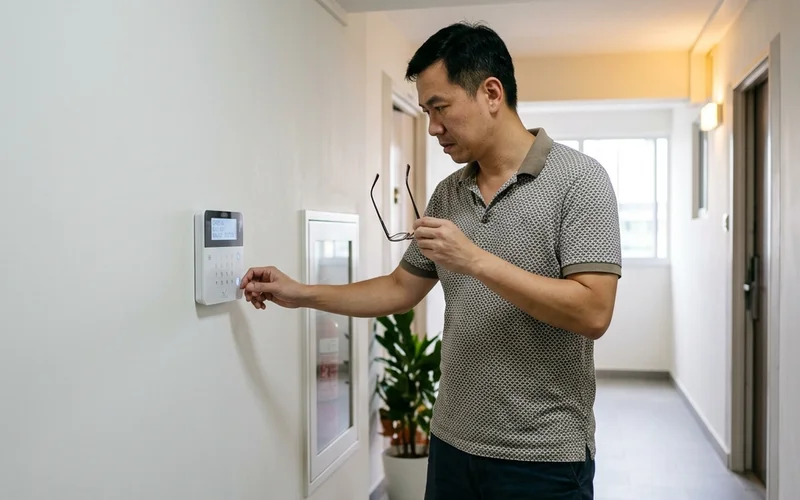
The procedure is straightforward. Enter walk-test mode from the keypad, then move through every protected area of the property. Open each protected door and window. Walk through the field of view of each motion detector. The panel should register each zone in sequence. If a detector does not register until you are very close to it, or fails to register at all, that zone requires attention; either a lens clean, a positioning adjustment, or a component replacement.
We recommend performing a walk-test at least once a month. This is not an onerous commitment, for a typical home with six to ten detection zones, the entire test takes under five minutes. The value is in catching gradual degradation early, before it becomes an undetected gap in coverage. A detector that responds correctly in January but only at close range in June is a detector that has been declining for months. A monthly test catches that decline when it is still easy to address.
PLANNING POINT
If your panel does not have a dedicated walk-test mode, consult the user manual or contact your installer. Most modern panels include this function. If yours does not, a supervised test with the monitoring centre on notice achieves the same outcome, but must be pre-arranged to avoid an unnecessary police call-out.
Backup batteries; the three-year rule
The backup battery inside the alarm control panel is the component most homeowners think about least and should think about most. During a mains power failure; whether from a trip, a fault, or a deliberate act of interference; the battery is the only thing keeping the alarm operational. A battery that cannot sustain the panel through a two-hour outage is a battery that has already compromised the system, regardless of what the keypad display shows.
Most residential alarm systems use sealed lead-acid batteries. These have a rated lifespan of three to five years under ideal conditions. In Singapore's climate, heat and humidity accelerate electrochemical degradation, and real-world performance often falls short of the rated figure. A battery installed four years ago in a panel located in a poorly ventilated utility area may have far less capacity than its label suggests, and may not display a fault warning until it is close to complete failure.
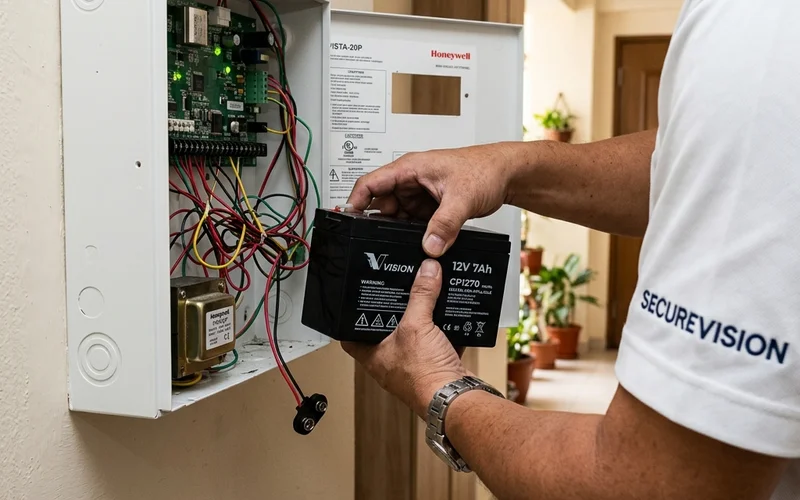
Our standard recommendation is to assess the backup battery at three years and replace it proactively. Waiting for a low-battery fault warning is not an unreasonable approach, but it means accepting that the battery has already degraded to a point where the panel felt it necessary to alert you. A proactive replacement at three years costs very little and removes the risk of a silent failure during an actual power interruption.
If the keypad displays a low battery warning, a communication failure alert, or begins triggering false alarms at night; a classic symptom of voltage fluctuation from a weakening battery; address it immediately. These are not minor inconveniences. They are the system telling you that one of its most critical components is failing.
KEY POINT
A failing backup battery can cause the entire alarm system to behave erratically, including triggering false alarms in the early hours of the morning as the battery voltage drops and recovers unpredictably. If unexplained false alarms begin occurring, the backup battery is the first component to check.
Cleaning detectors and checking coverage
Passive infrared motion detectors work by detecting changes in heat signature as a person moves through their field of view. The detection element sits behind a Fresnel lens; a ribbed plastic optic that focuses infrared energy onto the sensor. Dust, cobwebs, and small insects on the lens surface reduce the amount of infrared energy reaching the sensor, which in turn reduces the detector's effective range and sensitivity. A detector that was correctly covering a room at installation may, after two years without cleaning, only reliably detect movement within half that distance.
Every six months, wipe the exterior of each motion detector gently with a dry lint-free cloth. Pay particular attention to the lens face. Do not use cleaning chemicals, spray cleaners, or wet cloths; these can leave residue on the lens or, in the case of solvent-based products, damage the Fresnel optic permanently. The cleaning process takes less than a minute per detector and costs nothing.
While cleaning, also check the physical coverage of each detector. Renovation works, new furniture, added partitioning, and changes to room layout can all create blind spots that were not present when the system was designed. A sofa positioned between the detector and the main entry route into a room, a new wardrobe that narrows the field of view, or a curtain that partially blocks the lens are all worth identifying and addressing. Coverage should reflect how the room is currently used, not how it was configured at the time of installation.
Securevision's View
Detector cleaning is the maintenance task most homeowners skip because it does not seem consequential. In our experience, it is one of the most common causes of reduced system performance we find on site, not a dramatic failure, but a gradual narrowing of detection range that nobody notices until a walk-test reveals that a sensor only reacts at close range. Two minutes and a lint-free cloth twice a year prevents this entirely.
The siren battery most homeowners forget
Almost every homeowner who maintains their alarm panel battery forgets the battery inside the external siren. The two are separate components with separate power supplies, and the siren battery serves a specific and critical purpose that the panel battery does not.
The external siren; the bell box mounted on the outside of the building; contains its own internal battery precisely to allow it to continue operating if the main wiring between the panel and the siren is cut, if power to the panel is interrupted, or if someone attempts to tamper with the connection. If the siren battery has failed, the siren may fall silent immediately when any of these events occur, which is exactly the scenario a determined intruder would attempt to create.
Siren batteries are typically sealed lead-acid units of smaller capacity than the panel battery, and they degrade at a similar rate. They should be assessed on the same three-year cycle as the panel battery. In Singapore's outdoor conditions; direct sun, high humidity, and heat; siren batteries may degrade faster than those inside a climate-controlled panel location. If the siren is mounted on a west-facing wall in direct afternoon sun, treat the assessment interval as closer to two years rather than three.
KEY POINT
When arranging a maintenance visit, explicitly ask your engineer to check the siren battery as well as the panel battery. It is often omitted from basic service checks unless specifically requested. The siren battery is the last line of defence if wiring is tampered with; it should not be the most neglected component in the system.
Bypass zones; temporary should mean temporary
Most alarm systems allow individual detection zones to be bypassed; excluded from the armed system temporarily. This is a legitimate and useful feature. If a detector develops a fault and begins generating false alarms, bypassing that zone while the fault is investigated allows the rest of the system to continue operating. If a protected window needs to be left open during renovation works, bypassing the window contact for that period avoids nuisance activations.
The problem arises when temporary bypasses become permanent. We regularly encounter systems where a zone was bypassed months or years earlier; because a detector was generating false alarms, because a contact was broken, because a window was left open during a renovation that finished long ago, and was never reinstated. The alarm continues to arm normally. The keypad shows the system as armed. But part of the property is not protected, and the owner has forgotten why the zone was bypassed in the first place.
A simple check is to review the bypass status of each zone when arming the system. If any zone shows as bypassed, confirm that there is a current and valid reason for that bypass. If a detector has been bypassed because it was generating false alarms, treat that as a maintenance issue to be resolved rather than an acceptable operating state. A detector that causes false alarms needs to be cleaned, adjusted, or replaced, not permanently excluded from the system.
PLANNING POINT
If you find yourself repeatedly bypassing the same zone to arm the system without nuisance activations, that zone needs maintenance attention, not a permanent bypass. A bypassed detector is an unprotected area. The alarm system is showing you a fault through its behaviour; the correct response is to fix the fault, not to work around it.
Checking your communication path
An alarm system that detects a breach but cannot communicate that breach to a monitoring centre or the homeowner's phone has failed at the most critical moment. The detection and communication functions are separate, and the communication path must be tested independently of the detectors.
If your system reports to a professional monitoring centre, arrange a supervised test at least once a year. Notify the monitoring centre before starting, then arm the system and trigger a detector deliberately. Confirm that the monitoring centre receives the alarm signal within the expected timeframe and that their operator calls back to verify. This confirms the full chain; detection, panel processing, signal transmission, and monitoring centre receipt; is working end to end.
If your system sends notifications to a mobile app, test the notification path separately. Change of phone, operating system updates, app updates, and changes to mobile data or Wi-Fi settings can all break notification delivery without any fault appearing on the panel. Many homeowners discover that app notifications stopped working months ago only when they attempt to test the system after an incident. The test should be performed after every phone replacement and at least annually otherwise.
If your alarm communicates via a standard telephone line, be aware that Singapore's analogue telephone network has been progressively decommissioned. Alarm panels relying on PSTN signalling may have lost their communication path without displaying a fault, because the panel cannot always distinguish between a connected but inactive line and a disconnected one. If the panel was installed more than five years ago and has not been verified to communicate via mobile network or IP, this should be confirmed as a priority.
Securevision's View
A communication failure is the failure mode that matters most, and the one that is tested least often. We have attended sites where an alarm had been installed for years, armed and disarmed daily, and appeared to be functioning normally, and where a supervised test revealed that alarm signals had not been reaching the monitoring centre for an extended period. The detection system was working. The communication path had failed silently. Annual supervised testing is not a formality; it is the only way to confirm the complete chain is working.
In Short
Most burglar alarms fail gradually and silently, not dramatically. The checks that prevent this; a monthly walk-test, a three-year battery replacement cycle for both the panel and the siren, a biannual detector clean, a review of bypassed zones, and an annual supervised communication test; require no specialist knowledge and take very little time. What they require is consistency. An alarm system that is tested regularly is one that can be trusted when it is needed. An alarm system that has never been tested is, in our experience, often one that would have failed to perform.

Frequently asked questions
My alarm still arms normally. Does that mean everything is working?
Not necessarily. An alarm panel can arm and disarm correctly while individual components have already begun to fail. A detector that has lost sensitivity will still register as active in the zone list. A backup battery that can no longer sustain a power outage will not display a fault until it is close to complete failure. The walk-test and battery check are the only reliable ways to confirm that the system is functioning as intended, not just appearing to.
How often should I perform a walk-test?
At least once a month. The walk-test takes under five minutes for a typical home system and is the earliest warning of gradual detector degradation. Annual testing catches problems that have been developing for up to twelve months. Monthly testing catches them within weeks, when they are far easier and less costly to resolve.
How long do alarm backup batteries last in Singapore?
Most sealed lead-acid alarm batteries are rated for three to five years under controlled conditions. In Singapore's heat and humidity, real-world performance often falls at the lower end of that range, particularly in panels located in non-air-conditioned spaces. We recommend assessing the battery at three years and replacing it proactively rather than waiting for a fault to appear.
My keypad shows a fault warning but the alarm still works. Should I investigate?
Yes, immediately. Many alarm panels continue to arm and disarm with active fault conditions, but the fault warning means a component is already outside its normal operating parameters. Common causes include a degrading battery, a zone that has lost communication, or a communication failure to the monitoring centre. None of these resolve themselves, and all worsen over time if left unaddressed.
Is the siren battery the same as the panel battery?
No. They are separate components with separate batteries. The panel battery keeps the control electronics running during a power failure. The siren battery allows the external bell box to continue sounding if the wiring between the panel and the siren is cut or if power to the panel is lost. Both must be maintained on the same replacement cycle.
What does it mean if a zone is showing as bypassed when I arm the system?
It means that detector zone is excluded from the armed system and is not providing any protection. Bypass is intended as a temporary diagnostic measure. If a zone is showing as bypassed and you do not have a current reason for that bypass, reinstate it and investigate why it was bypassed originally. A frequently bypassed zone is a zone with a maintenance fault that has not been properly resolved.
My alarm communicates via a phone line. Is that still reliable?
Singapore's analogue telephone network has been progressively decommissioned. If your alarm panel communicates via PSTN; a standard phone line; its signalling path may have been disrupted without any fault appearing on the panel. Panels that have not been upgraded to communicate via mobile network or IP broadband should be tested with a supervised call to the monitoring centre to confirm signals are still being received.
Should I test my monitored alarm myself?
Yes, but always notify the monitoring centre before starting. A supervised test, where you deliberately trigger the alarm and confirm the monitoring centre receives the signal and contacts you within the expected timeframe; is the only way to verify the full communication chain. We recommend doing this at least once a year, and after any change of phone, SIM, or internet service provider.
Can I clean the detectors myself?
Yes. Wipe the exterior of each motion detector lens with a dry lint-free cloth every six months. Do not use cleaning chemicals, spray cleaners, or wet cloths. The Fresnel lens is a precision optical component and solvent-based products will damage it permanently. The cleaning process requires no tools and takes under a minute per detector.
How do I know if my alarm has a walk-test mode?
Check the user manual for your panel model. Most modern residential alarm panels include a walk-test mode accessible from the keypad. If you no longer have the manual, the model number on the panel face or inside the panel cover can be used to locate the correct documentation online, or you can contact your installer to confirm the procedure for your specific system.
Is there a legal requirement to maintain a burglar alarm in Singapore?
There is no general legislative requirement for residential property owners to maintain their burglar alarm systems. However, if your alarm is professionally monitored and generates excessive false alarms, the Singapore Police Force may impose conditions on continued police response. Maintaining the system to reduce false alarm rates is therefore not only good practice; it protects your entitlement to police assistance when the alarm is genuine.